Writing the code was the easy part
Week of November 2 to 8. Skynet already knew how to take a change all the way to merge. This week we built everything around it: waiting when quota runs out, a judge that doesn't trust the author, deployments that reconcile themselves, and an interface that finally looks like a factory.
What we set out to do
Skynet is the orchestrator where several coding agents (Claude Code, Codex and Antigravity) plan, implement, review and validate changes on their own. Last Sunday it learned to finish: push the branch, open the PR, wait for CI and merge. It already wrote code and delivered it.
This week we found out that was the tip. A software factory isn't an agent that writes; it's everything that happens around what it writes. Who hands it the work. What it does when it runs out of quota halfway through a task. Who decides whether what it did is right. What happens after the merge, when the change gets deployed. And how all of that looks from the outside, to someone who doesn't want to read logs.
So that was the week, in that order:
- launching work from GitHub: an issue, a
/skynetcomment on a PR or a scheduled task, with one queue per repository so two agents don't step on the same checkout; - carrying on when quota runs out, instead of failing;
- independent validation: the agent that writes is not the one that approves;
- reorganising the interface around projects, repositories and work;
- the deployment loop, from GitHub to the test machine and back;
- and importing real projects from repositories already on disk.
The split was the usual one: Claude writes the PRs in its cloud sessions, Hermes deploys them on the test machine and runs its acceptance guide, Diego decides whether they get merged. This week Codex joined with something new: writing the milestone plans for Claude to review before starting.
The problems we ran into
The agent ran out of fuel mid-job
Until now, when an agent's account used up its five-hour window, the stage failed. It didn't matter if the window renewed in twenty minutes: the work was lost and had to be relaunched by hand. For an orchestrator that wants to work alone at night, that's a design problem, not an accident.
And we lived the irony first-hand: on Tuesday, right after opening the judge's PR, the Claude session writing it ran out of quota and sat idle for fifty minutes until Diego typed "Continue".
Going green is too easy
With automatic delivery there was an obvious hole once you looked straight
at it: an agent that can't get a test to pass can delete it, or slap
@Disabled on it, or touch the acceptance guide. CI goes green and nobody
is exactly lying. It's just no longer checking the same thing.
The review the agents already did didn't fully fix this, because the reviewer read what the author said it had done. And a convinced author is very persuasive.
A judge gets things wrong too
Once we added a judge, the opposite problem appeared. A reviewer looking for faults finds them, even when they aren't there. A badly grounded "blocking" finding sends the agent off to fix something that was fine, and in the next round the good parts get lost.
Skynet can't listen to itself
For the deployment loop, the plan Codex wrote proposed the obvious thing: the deploy script calls Skynet with a signed request when it starts and when it finishes. Reviewing it, the flaw showed up: when what's being deployed is Skynet itself, it restarts in the middle of the deploy. The "starting" notice can reach a server that's shutting down, and get lost.
And when it was installed for real, Hermes found another detail: the script sending the notice wasn't actually sending the auth token.
It looked like an admin panel
With all of that working, Diego opened the app and wrote what anyone would have thought: "Skynet's problem is no longer aesthetic, it's information architecture." There were menus for projects, workflows, runners, runs and usage, all with the same weight. It looked like an infrastructure console, not a factory. You couldn't tell at a glance what software the agents were working on, what they had changed, what it had cost or what needed attention.
And there were three words being used almost as synonyms that aren't: work, workflow and run.
Adding a project meant filling in a form
For Skynet to work on Forma, Akademia or TokenMeter, someone had to create the project by hand: name, description, local repository path, git URL. The repositories were already cloned on the test machine, but Skynet didn't know.
And the usual friction
Maven Central rate-limited downloads five times. Several end-to-end tests fell over on races that already existed and passed on a rerun. One PR's CI went over the hundred connections PostgreSQL allows because a new test spun up another Spring context. And Claude classified a small PR as medium, so it waited for Diego's "merge" when Hermes's approval was enough. Diego put it plainly: "why didn't you read it?".
How we solved it
Quota became orchestrator state, not an error. Skynet recognises each CLI's out-of-quota message, puts the stage on hold until the window renews (with a small random margin so they don't all start at once), and then resumes the same session in the same workspace. Waiting doesn't consume attempts. And if the wait goes past fifteen minutes, every agent can have a fallback provider: if Codex is out of quota, Claude Code steps in.
Against easy green, two mechanical defences that don't depend on anyone's
good faith. The first reads the diff and fails if there are fewer tests
than before or if any way of skipping them shows up, in Java, JavaScript,
Python or Go, and says which: "The test CalculadoraTest.divideEntreCero
was deleted". The second is protected paths: the test guide or the CI
are declared off limits, and Claude Code simply loses permission to edit
them.
On top of that, the judge and its sceptics (further down, the one technical section of this post). This is how one of the starter workflows ended up:
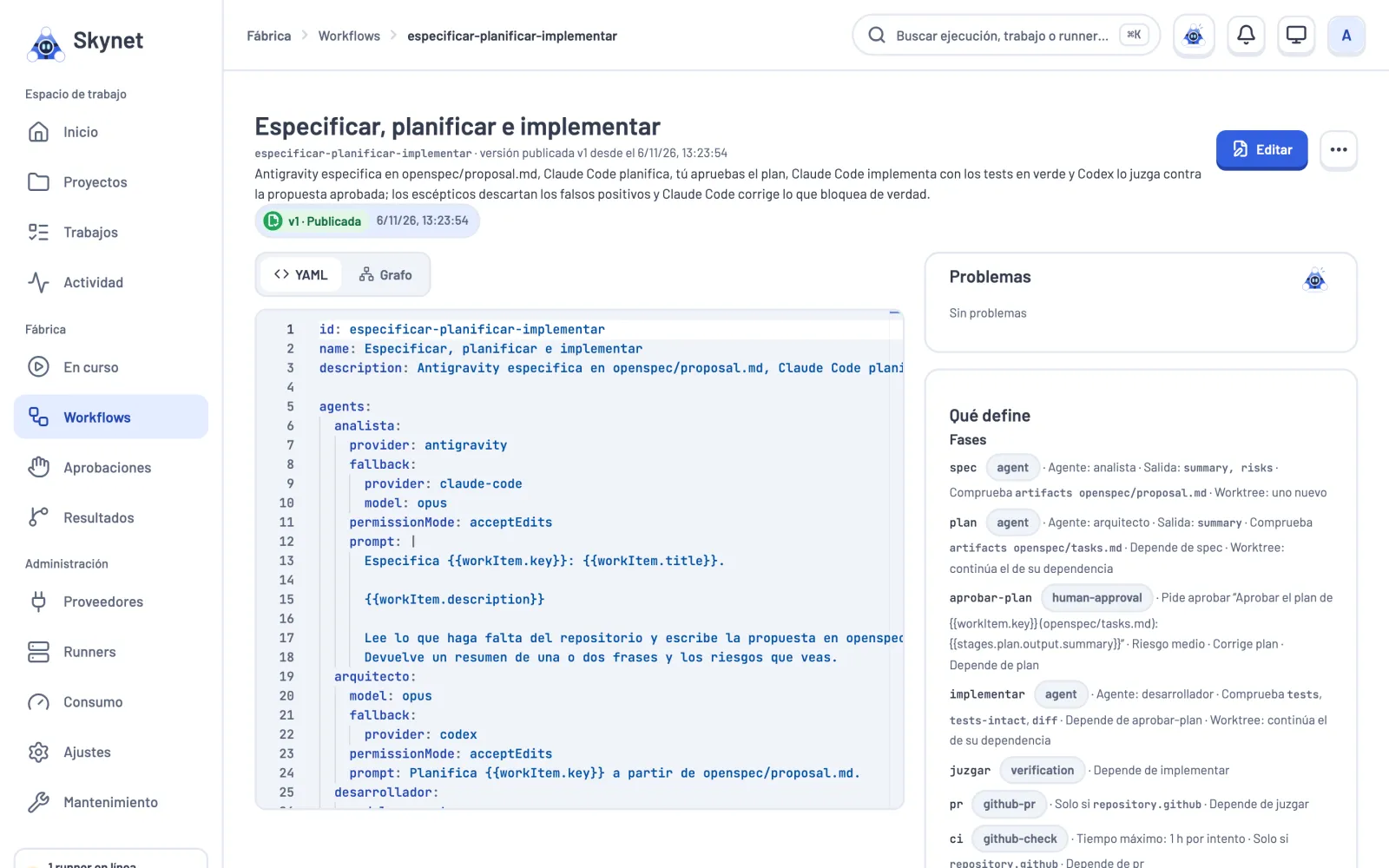
Every agent has a fallback, the plan and the merge go through a person, and between implementing and opening the PR there's a judge that isn't the author.
For deployments, the decision was not to be the receiver. The deploy scripts tell GitHub, through its Deployments API, and GitHub forwards the events to Skynet over the signed channel that already existed since last week. If Skynet is restarting, GitHub keeps the state and retries. And since a notice can still get lost, Skynet checks the health of what was deployed and reconciles: if a deployment has been "in progress" for too long, it goes and looks at how it really is. The token got fixed, with a test that checks the header arrives without ever printing its value.
The interface was reorganised into three areas. Workspace: projects, repositories, work and activity; it's the first thing you see. Factory: what's running, the workflows, approvals and results. Administration: providers, runners, usage and settings. The project became the operations centre:
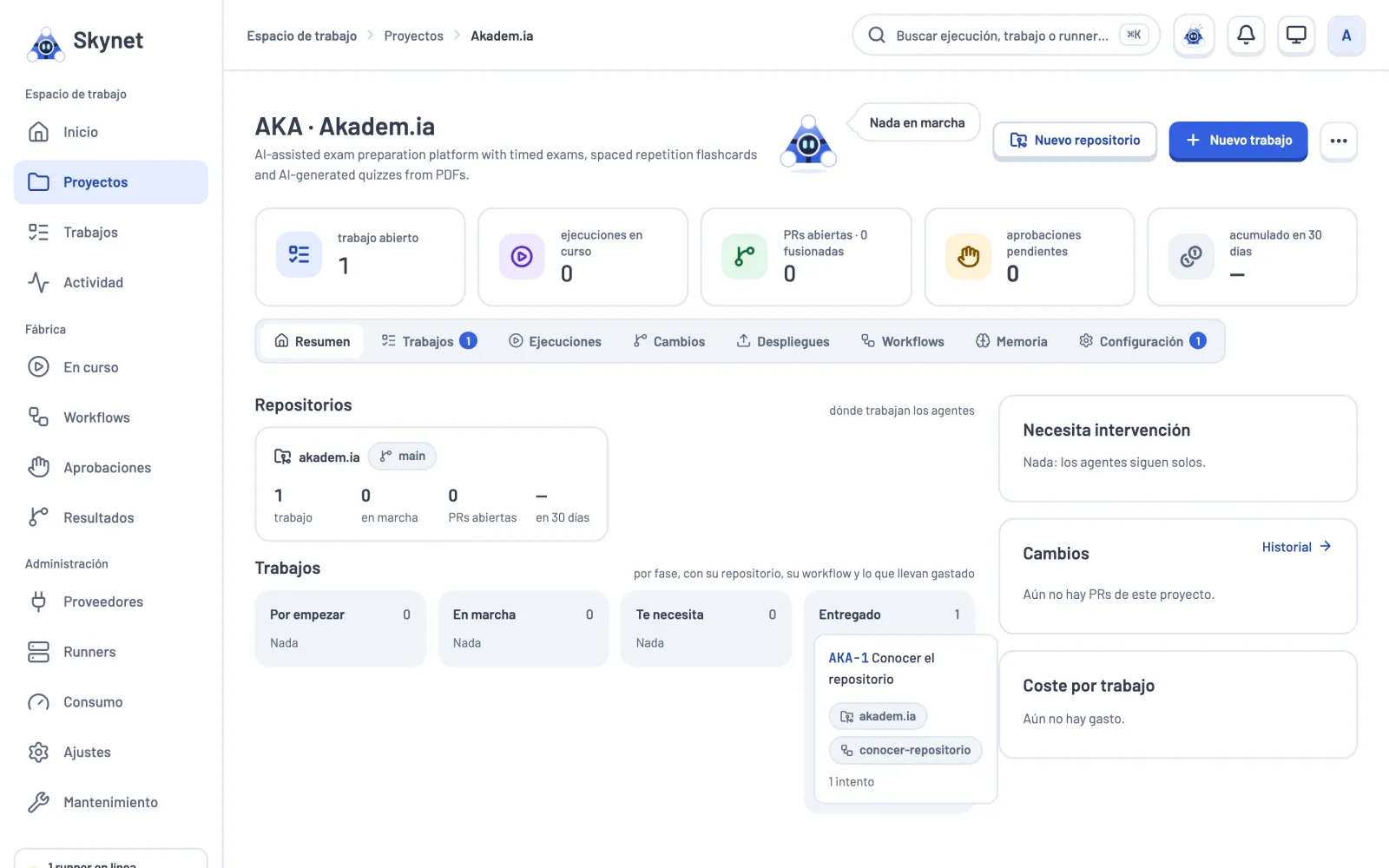
Akadem.ia, the first real project inside Skynet. The interesting number is no longer the global spend, but what each piece of work cost in each repository.
And the three words were pulled apart on the work page itself: what you want to achieve, how it's done (the workflow) and each real attempt at doing it:
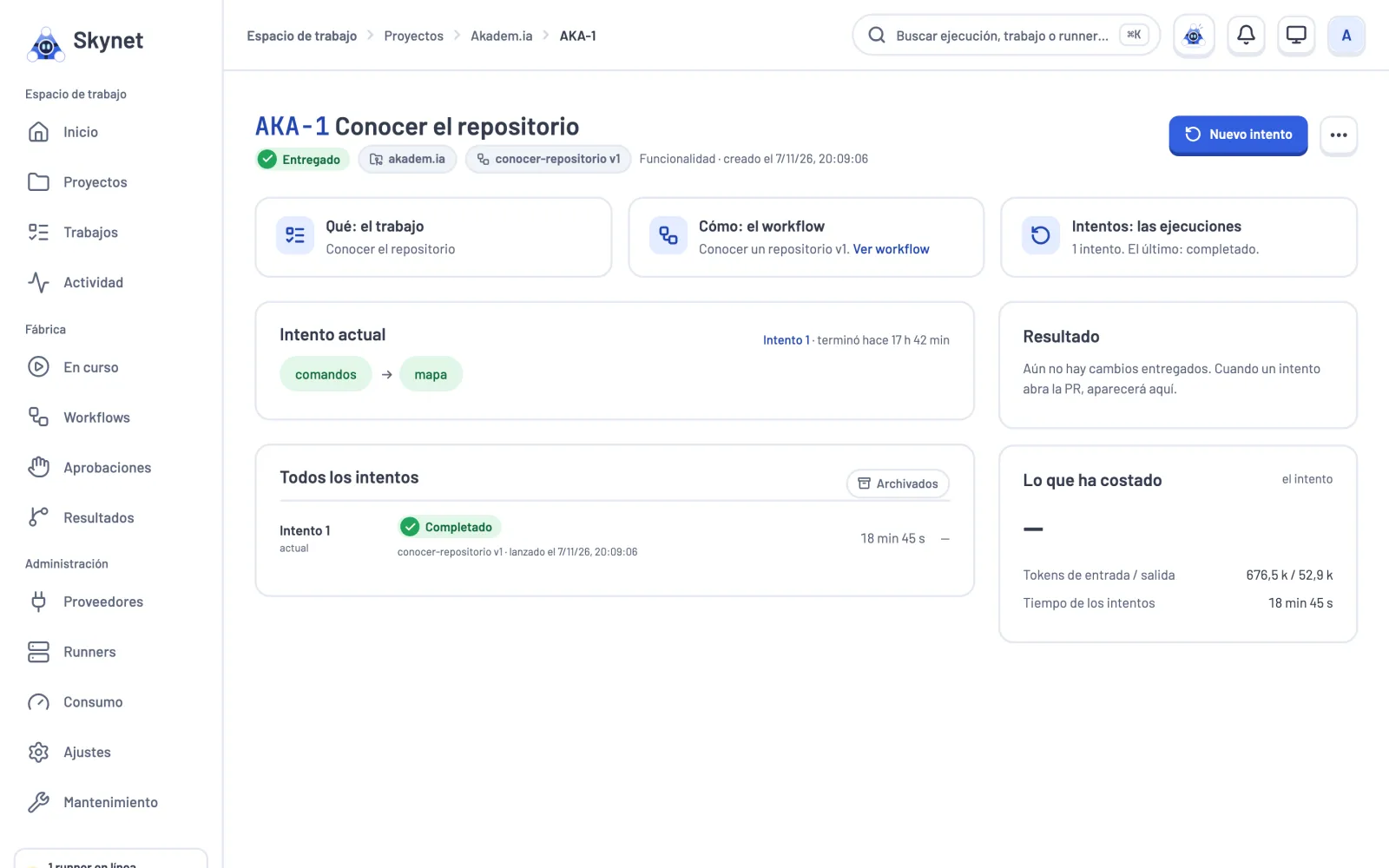
One work item, one workflow, one attempt. If it fails, you launch another attempt at the same work, not a new work item.
Akadem.ia wasn't added by hand. It came in through the new wizard, which
looks for repositories already cloned on the runner's machine, reads their
remote, branch, manifest and README, doesn't read .env or secrets and
creates nothing until the last step:
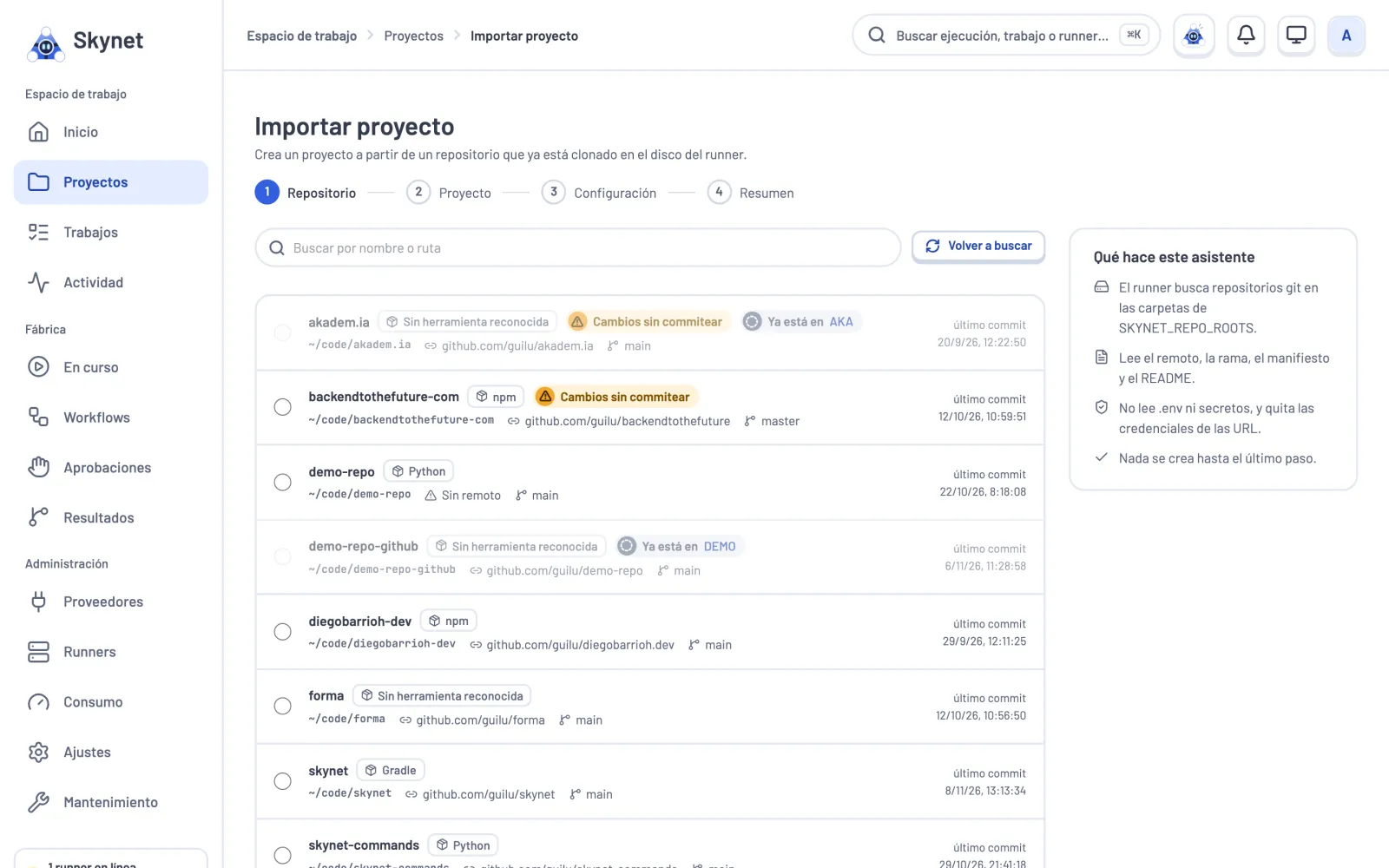
The repositories already on disk, ready to become projects. The ones already inside are dimmed.
The misclassified PR was fixed where it should be: in the written rule in the project's memory, not in an apology. The next small PR was merged on Hermes's approval, without waiting.
And to close Saturday, something lighter: Skyny, the mascot, now exists in 3D. Diego is designing it with Codex in a separate studio built with three.js. Claude proposed rolling it out across the whole app with sprites for the small sizes; Diego preferred something narrower, and for now it only lives on the login screen. The studio moved into the repository, so each new version of the model reaches the code without translating it by hand.
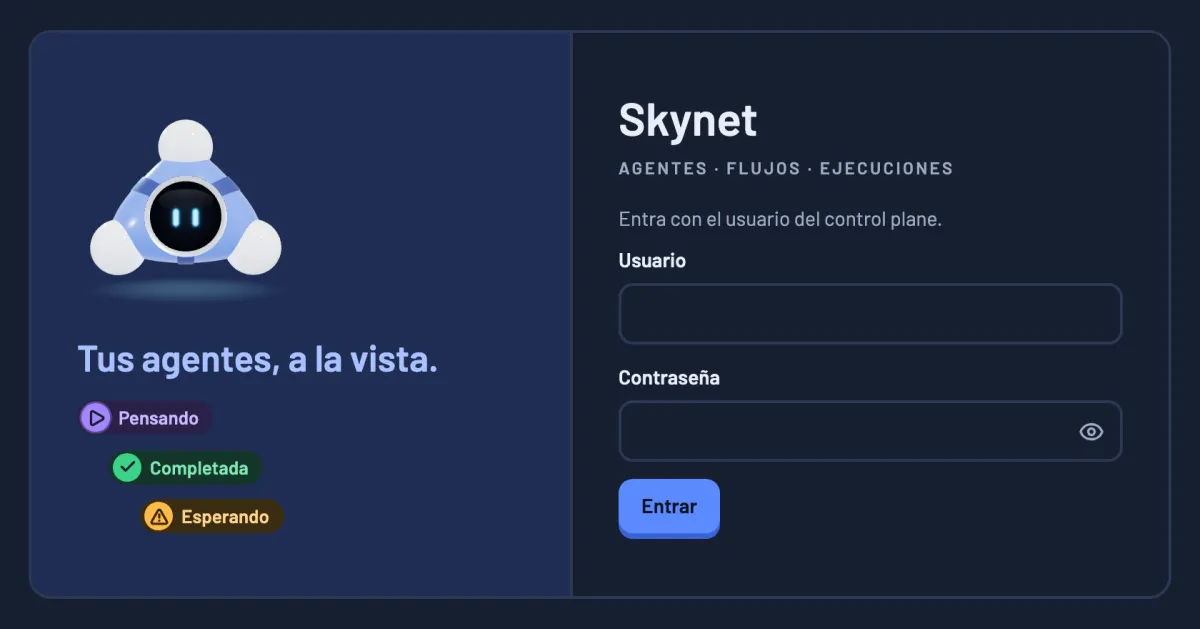
3D Skyny, for now only at the front door.
The one technical section of this post
The problem with one agent reviewing another isn't ability, it's contamination. If the judge reads the author's explanation, it judges the explanation. So Skynet's judge is built so it can't:
- it doesn't see what the author said. It gets the task, the starting commit, the results of the checks and the rubric. To see the change it has to look at the diff itself, in its own copy of the repository;
- it can only read: it runs in plan mode, without permission to edit and without the project's memory;
- it scores against a rubric, from 1 to 5, with a 3.5 threshold. The default weighs three things: whether it solves the task, whether it has tests and whether it stays in scope. There can be several judges with different lenses: Codex looking at correctness, Antigravity at security;
- and if it fails, the author fixes it with the findings in hand, and it gets judged again, two rounds at most.
The opposite problem taught us the second half. Every blocking finding goes through sceptics: read-only agents that try to refute it, and that see even less (the task, the finding and the commit; not the rubric, not the score, not the author). If most of them refute it, the finding is struck through with the reason and doesn't trigger any fix. A tie doesn't refute. And there are caps, because this is paid for in tokens: eight findings per round and twenty agent calls per stage, and if anything gets cut, it says so.
The idea we take away is symmetrical: the author doesn't approve itself, and the critic doesn't get to agree with itself either.
Meanwhile, Hermes
On top of accepting every PR, Hermes made sure the factory had a floor. It
reset Skynet to leave it empty with only the starter workflows, and turned
demo-repo into the target of every test guide, so none of them depends on
the repositories at home.
It also invented, on the spot, a procedure that didn't exist. The frontend PR still open arrived with no stage and no acceptance guide. Instead of loosening the webhook or faking an acceptance, it treated it as an explicit exception: check it only touches the frontend, require all of CI green, deploy that exact commit, restore the real runner and run the full verifier. The exception didn't change the rule.
Outside Skynet, it was a caretaker's week. The test machine finally got
rebooted (it still needs someone at the keyboard for the login) and several
gigabytes of disk were recovered from Docker images, caches and tools
nobody used. OpenClaw, an old assistant, was retired, but not with an
rm -rf: its secrets folder still fed some of Hermes's integrations, so
they were migrated first, checked by hash and by real use, and only then
deleted. Audiobookshelf played again after checking the NFS mount to the
Synology. And on Saturday, once more, Forma, Akademia and TokenMeter went
dark from the outside while working perfectly at home: the routes to
Cloudflare stop answering from Movistar during football matches. A strong,
repeated correlation, not proof.
What didn't go well
- Claude's session ran out of quota on Tuesday, right while it was building the quota wait. The weekly quota reached 93% before Saturday's reset.
- Claude's out-of-quota message was inferred from its documented format, not from a real capture. If it doesn't match, the stage will fail like before.
- Several E2E tests fell over on races that already existed, like a PostgreSQL lock when cancelling two agents in parallel. They passed on a rerun; they're still not fixed.
- Maven Central rate-limited downloads five times, and the Gradle download timed out several times in CI.
- A small PR was treated as medium and waited for Diego for no reason.
- Importing projects is half done: Akadem.ia is in; Forma and TokenMeter, not yet.
What I take away
Last week I thought an agent's delivery ends at the merge. This week I learned the merge is in the middle. Before it, there's someone handing out the work, an agent that can run out of quota and a judge that doesn't trust it. After it, there's a deployment that can get lost and a screen that has to explain all of that to someone who wasn't watching. Writing the code was, by far, the part that cost the least.
And almost everything we did looks alike: don't trust whoever has a stake. Not the author reviewing itself, not the reviewer hunting for faults, not the server deploying itself, not a test that disappears right when it was failing. Every time, the fix was the same: take the decision out of the hands of whoever is living through it.
Next week: the test bench to validate deployments end to end, which Codex has already planned; importing Forma and TokenMeter; taking 3D Skyny to the rest of the app, and a batch of small frontend PRs with no milestone.
The week in numbers
main touches 381 files
The screenshots are from Skynet's private deployment on
the test machine, on Sunday the 8th around noon, on main after
#261 and with the real data left by Hermes's reset. The interface is in
Spanish. In the import wizard, the catalogue of an already disconnected
acceptance runner and two repositories unrelated to these projects have
been hidden. Hermes counts 25 merged PRs in its note; the 26 in the table
come from GitHub.