Skynet is becoming an AI factory
Week of October 26 to November 1. Skynet, our agent orchestrator, took its first step towards becoming an AI factory. It learned to carry a change all the way: push the branch, open the PR, wait for CI, fix it and merge. Along the way we found out how many tests were passing on whatever the previous one left behind.
What we set out to do
Skynet is the orchestrator where several coding agents (Claude Code, Codex and Antigravity) plan, implement, review and validate changes on their own. Last Sunday it already remembered what it did and had a mascot telling you what it was up to. But its work ended in an odd place: a branch in a folder on the test machine. For that change to go anywhere, someone had to push it, open the PR, watch CI and merge.
On Tuesday, Diego asked for deep research into what people are calling AI Factories: auditable, repeatable agent workflows that ship features end to end, with human approvals where they matter. He cited a Stripe system called Orbit as the reference. The research couldn't find it: no such thing exists under that name, and what does exist is Stripe's Minions. With the premise corrected, out came a roadmap of fourteen milestones in five stages. It was approved on Thursday night, and the starting point chosen:
- give Skynet its own identity on GitHub, no personal tokens;
- teach it to deliver: push the branch, open the PR, wait for CI, fix it if it fails and merge once the gate allows;
- and, in parallel, let Diego give it orders from his phone, talking to ChatGPT, through a GitHub issue.
Before that, the week opened by wrapping up the visual side: a screenshot generator for the whole app, version 3 of Skyny (the mascot has a name now), the new app icon and each provider's logo on the usage screen.
The loop was the usual one: Claude writes the PR in its cloud sessions, Hermes deploys it to the test machine and runs its acceptance guide, and Diego decides whether it merges. With one change: small, all-green PRs that Hermes asks to merge no longer wait for Diego.
The problems we ran into
A test that passed by accident
The first delivery phase, pushing the branch and opening the PR, failed
Hermes's acceptance. The guide checked that the agent had written a + b
into a calc.py, and it wasn't there. Nothing was wrong with Skynet's
code: the workspace the test used was the one left over from an earlier
run, and this time it didn't carry the expected change.
In other words, the earlier tests had passed because someone had left the
ground prepared. And it wasn't the only assumption of that kind. The
plans for the next two phases mentioned guilu/demo-repo on GitHub for the
real test. Halfway through, Diego asked the obvious question: "But does the
guilu/demo-repo repo exist?" It didn't. There was only a local demo-repo
on the test machine.
Runners pretending to be fine
Acceptance runs sometimes spin up simulated runners, so they don't burn the real agents' quota. Hermes noticed that some survived the test. The install looked healthy, the panel said "1 runner online", and behind it there was no real Claude Code, Codex or Antigravity. The next real run would have met an actor.
CI that switched operating systems without telling anyone
Midway through the GitHub milestone, the end-to-end tests went red on a PR
and also on main, which hadn't changed. GitHub had moved its runners to
Ubuntu 26.04, which Playwright doesn't support yet. Nothing in our code was
broken.
The last phase brought another red that wasn't ours: a database deadlock between the cleanup the Java tests run at the end and the runner's heartbeat, which writes quota every few seconds.
An order that couldn't be retried
Meanwhile, with ChatGPT, Diego set up the channel for launching work from
his phone: a private repository, skynet-commands, where an issue labelled
skynet:run fires a webhook to Hermes, and Hermes launches the workflow in
Skynet. The first order worked. The bridge rejected the second: the issue
body carried text outside the JSON block that defines the order. The text
was fixed… and nothing happened. Editing an issue doesn't fire the creation
event again.
Notifying can't be part of the work
The last requirement was getting a Telegram message when an order arrived and when it finished. The first version sent it inside the webhook request itself. It worked, but every message stretched the response, and if Telegram failed, the bridge failed with it. It's the same problem last week left unsolved: the report that never arrived.
How we solved it
Identity arrived in three deliveries. Skynet now has a GitHub App,
skynet-guilu, with installation tokens that last an hour and only work
for the repositories and permissions granted. GitHub's events come in
signed: an invalid signature gets a 401, a repeated delivery is recognised
by its ID and never processed twice, and the endpoint only listens on the
private network.
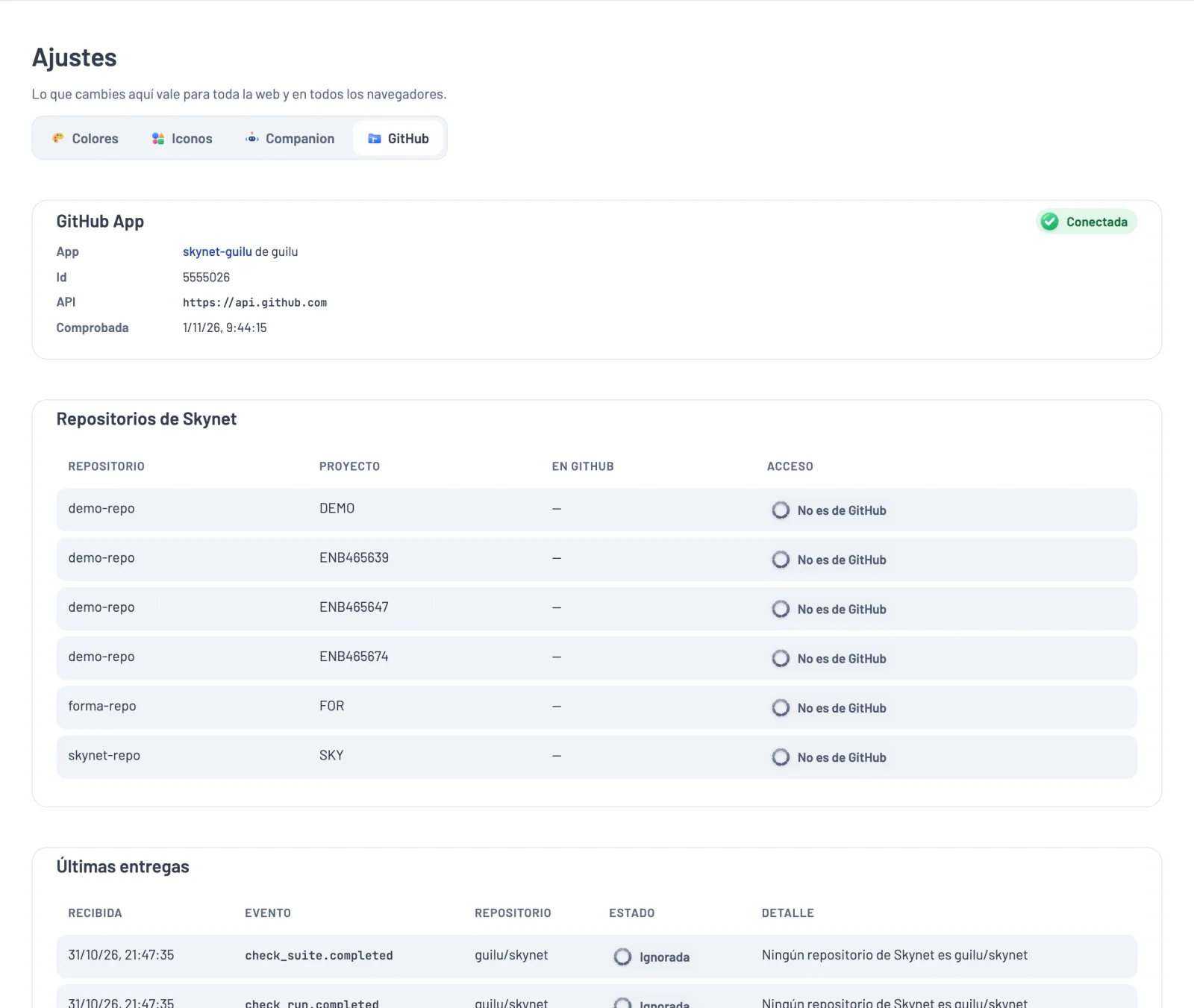
The App, connected. And the awkward truth underneath: every Skynet project still points at a local repository, so the events from its own GitHub repo are received, verified and ignored.
Delivery was split into three phases that build on each other: push and open the PR, wait for CI and fix it (the agent no longer calls its task done on push; it reads the checks, interprets the failure and goes back to work) and merge only after the gate. And the local flow, with no GitHub, still works: it skips those phases and doesn't show a PR card for a PR that doesn't exist.
For tests, the new rule is that every scenario prepares and cleans up its own repository. A temporary one is created, used during the flow and deleted at the end. A shared, mutable demo repository turns every acceptance run into a lottery that depends on the order the previous ones ran in.
The runners were solved by making them an invariant: every acceptance run ends by restoring the real runner and proving it with API data: a single runner online, the three real providers, none simulated, and no fake process still alive. If that doesn't hold, the queue doesn't move.
For CI, the call was not to mix things: a separate six-line PR that pins
ubuntu-24.04. A third party's fix doesn't sneak into a feature. The
database deadlock was solved by changing the order in which tables are
emptied.
For orders from the phone, the rule got written down: correcting an order means opening a new issue, not editing the old one. The third order, with the right format, finished fine.
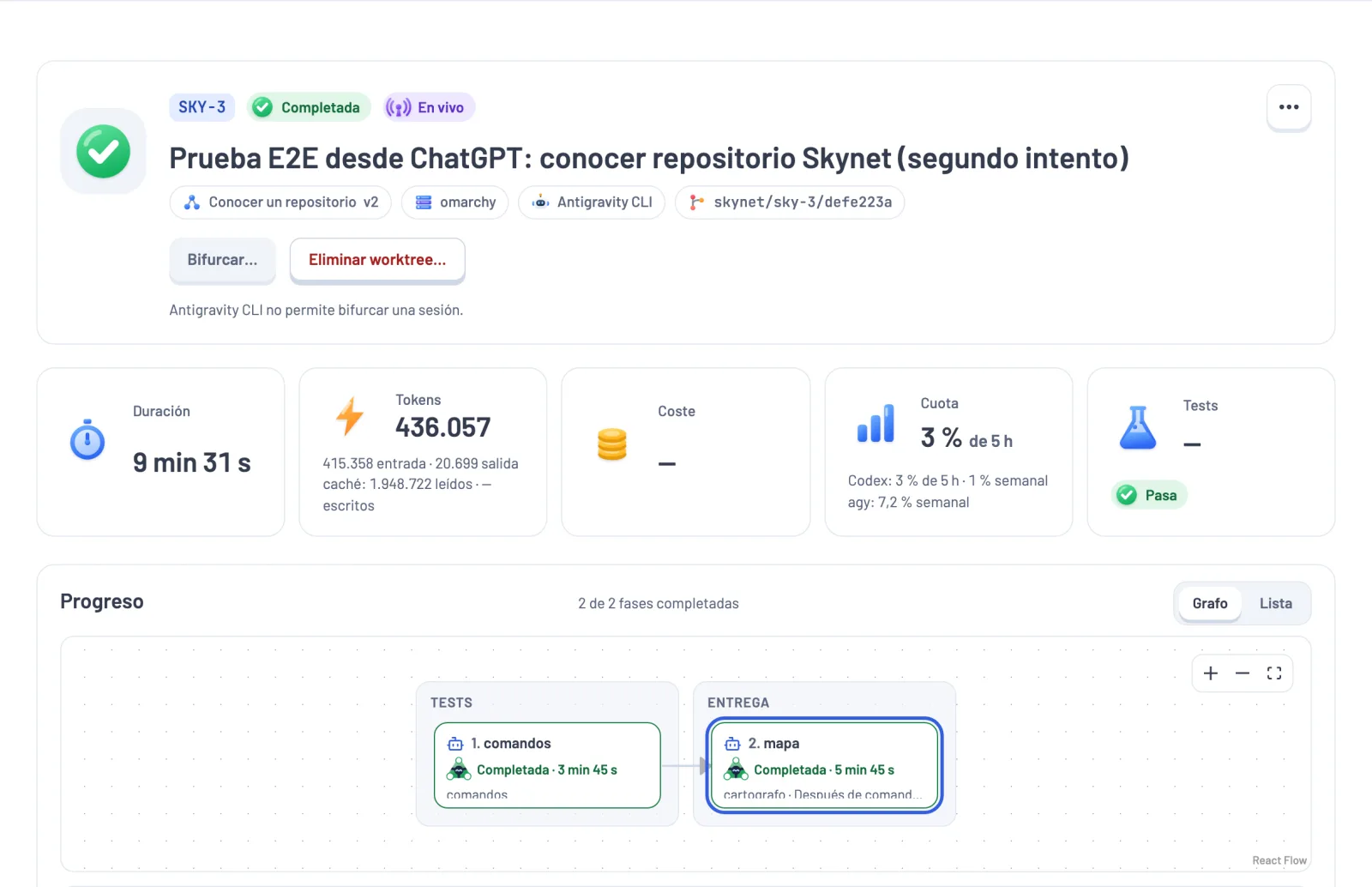
The order that came out of a conversation with ChatGPT: an issue on GitHub, a webhook to Hermes and Skynet getting to know its own repository. Second attempt, because the first couldn't be retried by editing.
And Telegram moved out of the request (below, the one technical snippet in this post).
On the visual side, the week left a generator that photographs the whole application on a throwaway database (160 screenshots across desktop and mobile, light and dark) and that, while at it, uncovered an old bug: a misplaced comment made the test runner use the user's home folder instead of its own. Skyny went through several rounds with Diego: the bands on its head came out upside down, the magnifying glass in "Reviewing" was too small for the hand holding it, and the seasonal hats covered the speech bubbles. Now it wears them tilted. This week, a witch's hat.
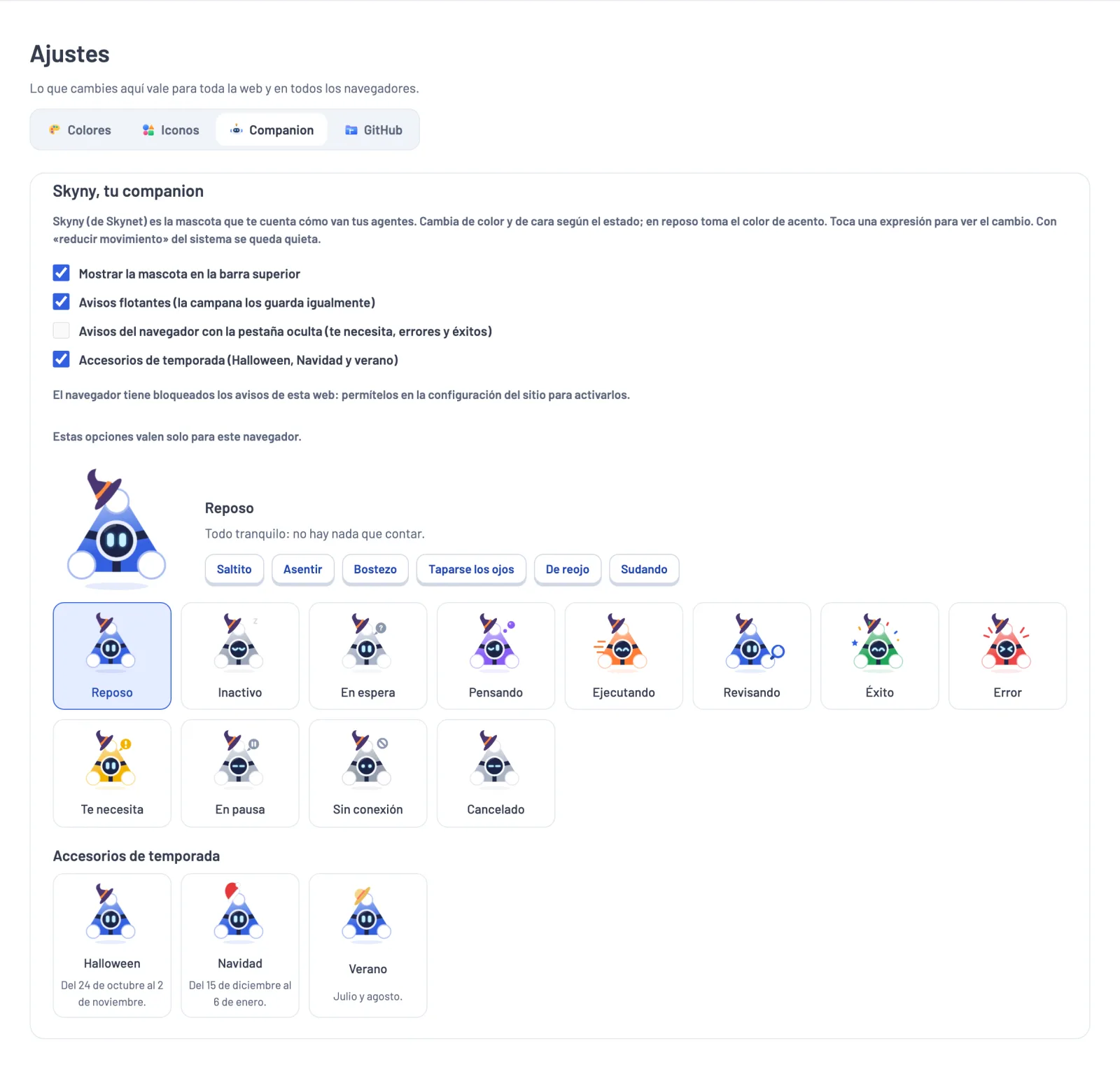
Skyny v3 with all its states. The hat only shows up between October 24 and November 2.
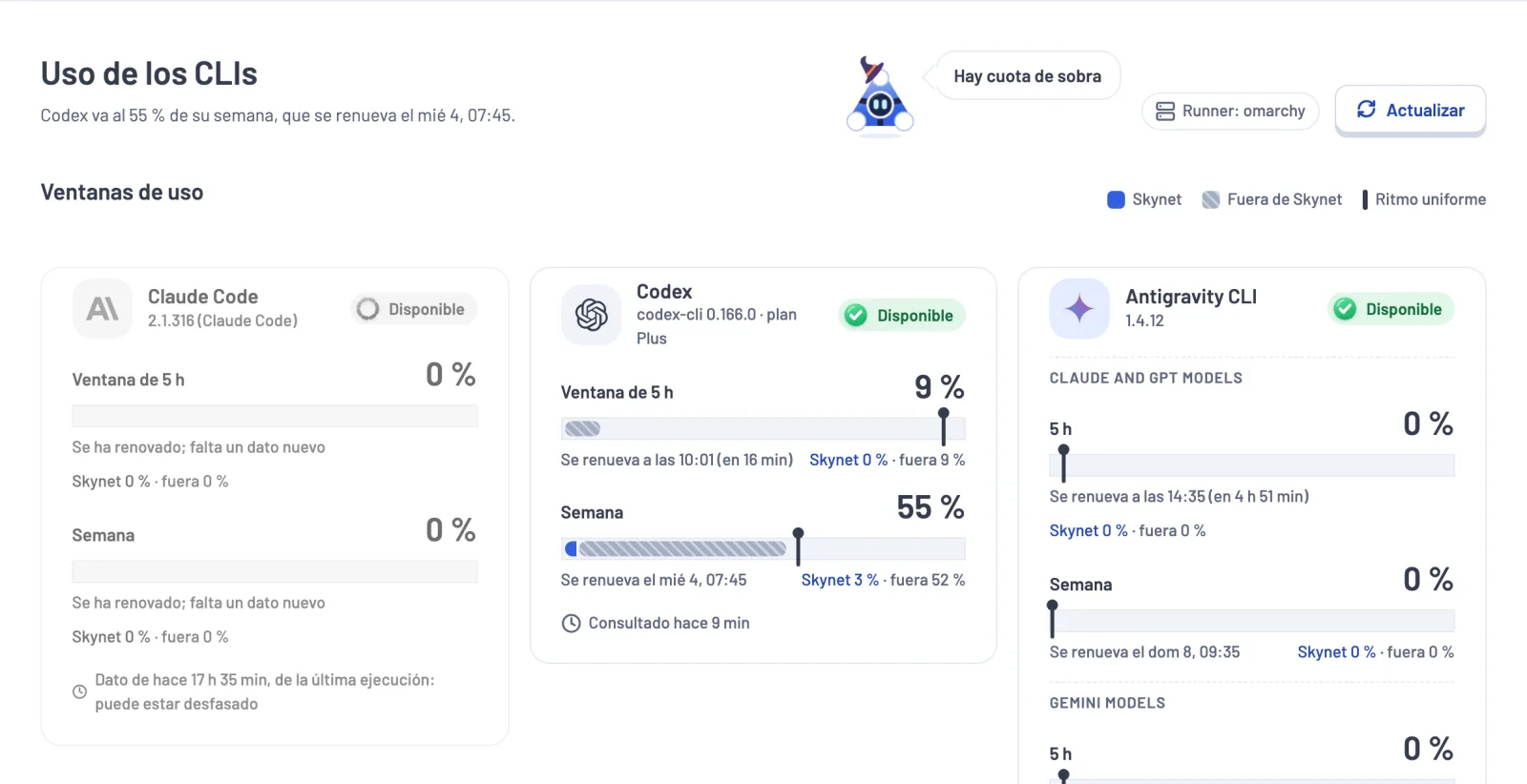
Usage, now with each provider's logo instead of a letter. The striped bar is what Diego spent outside Skynet.
The one technical snippet in this post
The Telegram problem is the problem of any external effect hanging off a transaction: if the notification is part of the work, a failed notification is a failed piece of work. And if retrying the notification also retries the work, the workflow launches twice.
The way out is a durable outbox, and the bridge implements it on SQLite:
- persist before notifying: receiving the webhook validates the order, stores its decision and enqueues the message in the same transaction. It answers straight away, without talking to Telegram;
- a separate worker claims and delivers: with a lease that expires if the worker dies and a claim token that stops two of them sending at once;
- the final state and its notification are written together: so a restart between "finished" and "notified" can't lose the message;
- retrying the notification never relaunches the work.
The adversarial review added what usually gets forgotten: escaping HTML, staying under Telegram's 4,096-character message limit, keeping tokens out of the logs and not leaving zombie processes in the healthcheck. Telegram can be down for an hour; Skynet won't notice.
Meanwhile, Hermes
Besides accepting every PR, Hermes had its operator week. It did a clean reset of Skynet and forced a split between four things a "delete everything" mixes up: runs, which can be wiped; the initial workflows, which get rebuilt; the project's memory and documentation, which must not disappear; and configuration and secrets, which never belong in a reset. It also wrote down an idea about quota: having real agents available doesn't mean running without limits, and those limits have to live in the orchestrator, not in a sentence in the prompt.
Outside Skynet, a Raspberry Pi hung and had to be power-cycled by hand. SSH looked stuck, but it was actually landing in a tmux session without showing the prompt; now the physical screen and SSH share the same session. The main computer's update is ready but not rebooted: on boot it stops at the graphical login, and it lives inside a cupboard. And the Alexa–Home Assistant integration went from sharing everything to sharing only the air conditioners.
What didn't go well
- Skynet's projects don't point at GitHub yet: the App is connected and deliveries arrive, but they're ignored. The test with a real project is for next week.
- Tests were relying on leftovers from earlier runs, and the plans on a repository that didn't exist.
- Two CI reds that weren't ours: Ubuntu 26.04 and the deadlock with the runner's heartbeat.
- Maven Central rate-limited downloads twice.
- The small-PR rule ran into the session's permission the first time, which still demanded Diego's "merge".
- The five-hour limit ran out on Saturday from 14:00 to 19:00, right in the middle of the delivery milestone.
- Rebooting the main computer remotely still needs someone at the keyboard.
What I'm taking away
This week Skynet learned to finish. And almost everything that was hard came from working out what that means: it isn't writing the code, or pushing, or opening the PR. It's CI passing, the gate being respected, the change being merged and someone finding out. Each of those steps is a state that can be lost if it isn't stored.
The other half of the lesson is about tests. An acceptance run that passes because the previous one left something prepared proves nothing. Not a shared repository, not a runner that "looks" real, not a plan that assumes something exists. Every test prepares its world, uses it, cleans it up and proves how it left it.
Next week: the first real external project, from issue to merge; the
milestone for launching work from GitHub, which looks a lot like what
skynet-commands already does; and quota budgets in the orchestrator.
The week in numbers
skynet-commands, per Hermes
main touches 400 files
The screenshots come from Skynet's private deployment on
the test machine, Sunday 1 in the morning, on 280ca12 and with
the real data from the acceptance runs. They are in Spanish, Skynet's UI
language. The installation's repository list was hidden in the GitHub tab.
There is no screenshot of a PR opened by Skynet: the GitHub acceptance runs
use temporary repositories that are deleted when they finish.