
My CI turned green without running a test
Week of 14–20 September. I built a CI job to verify database migrations against a real PostgreSQL. It passed first time, green, without running a single test. Pulling that thread surfaced the pattern that shaped the whole week: the system was full of claims nobody was checking.
What we set out to do
Forma is the training and nutrition app I'm building with AI agents. Last week I had three things on the list, and none of them was particularly exciting:
- Turn the plan generator into something real. Until now the wizard collected answers and produced nothing. It needed vocabulary, persistence, an API and a contract with the AI agent that writes the plan.
- Unify the domains. Akademia and Forma each lived somewhere else; time to
bring them under the same umbrella as TokenMeter, on
backendtothefuture.com. - Make the READMEs decent in the repos that had fallen behind.
What actually happened was something else. Midweek I set up a continuous
integration job to verify the database migrations against a real PostgreSQL,
because until then they were validated against H2 in compatibility mode. The
job passed. Green, first try. I stared at the log for a long while, because the
log said BUILD SUCCESSFUL and nothing else.
It hadn't run a single test.
From there I couldn't stop seeing the same thing everywhere. This week wasn't about nutrition plans or DNS. It was about claims nobody checks.
The problems we ran into
The dashboard assumed a plan that didn't exist
I started by implementing Google sign-in, the same one I already had in Akademia. It worked, and the first thing I did was log in with a brand-new, empty account.
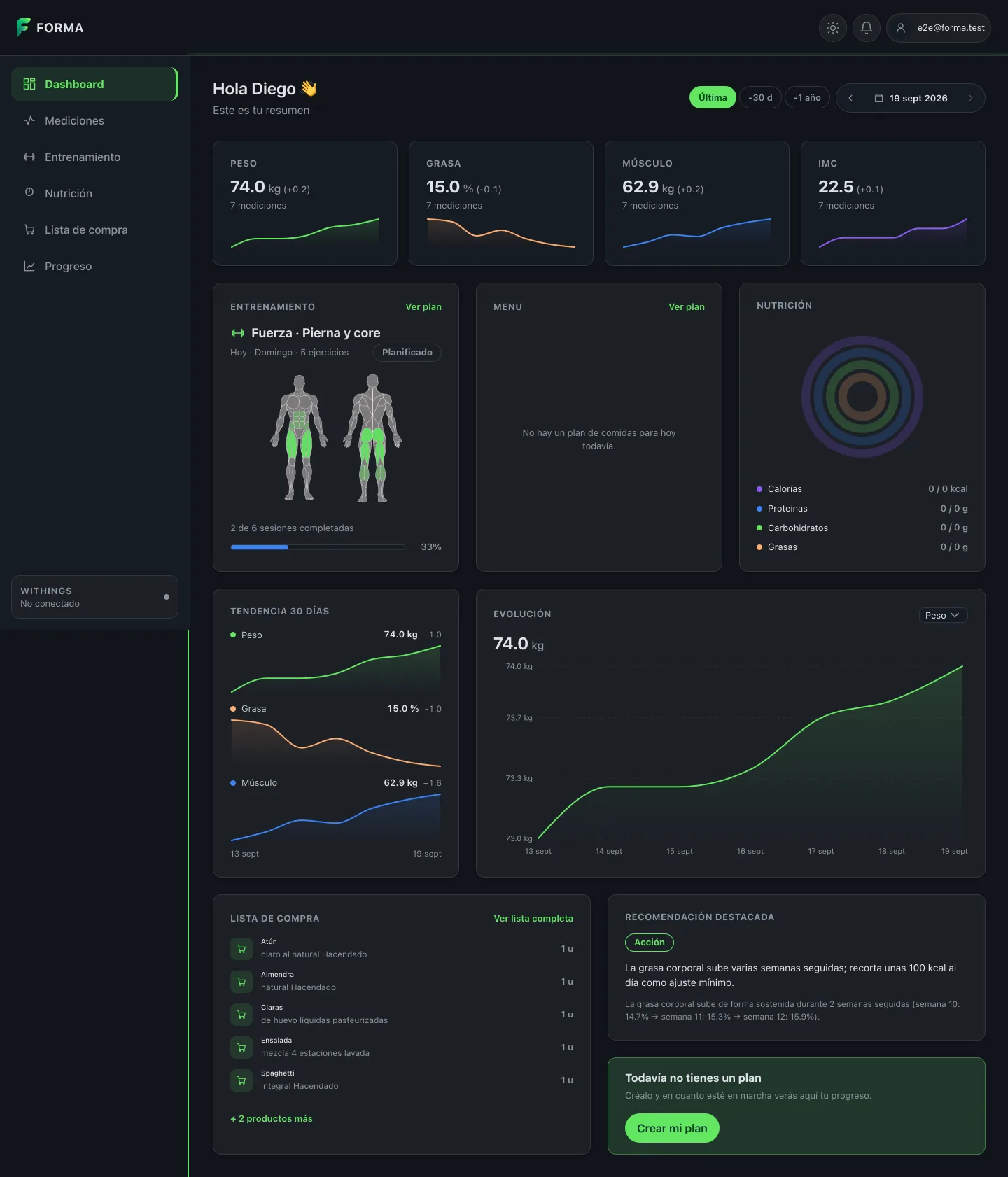
The dashboard greeted me with a banner reading "Your plan is under way".
There was no plan. There was nothing. The component never checked whether there was data behind it: it painted that sentence always, for everyone, from the first second. And two screens away there was a button, "Create your free plan", that led to the public, anonymous funnel on the landing page — a form that captures a lead and that, for someone already signed in, produces absolutely nothing. The user filled in four steps and came back exactly as they were.
Neither of those was a logic bug. Both were the interface claiming something the backend couldn't back up.
Guessing someone's calories
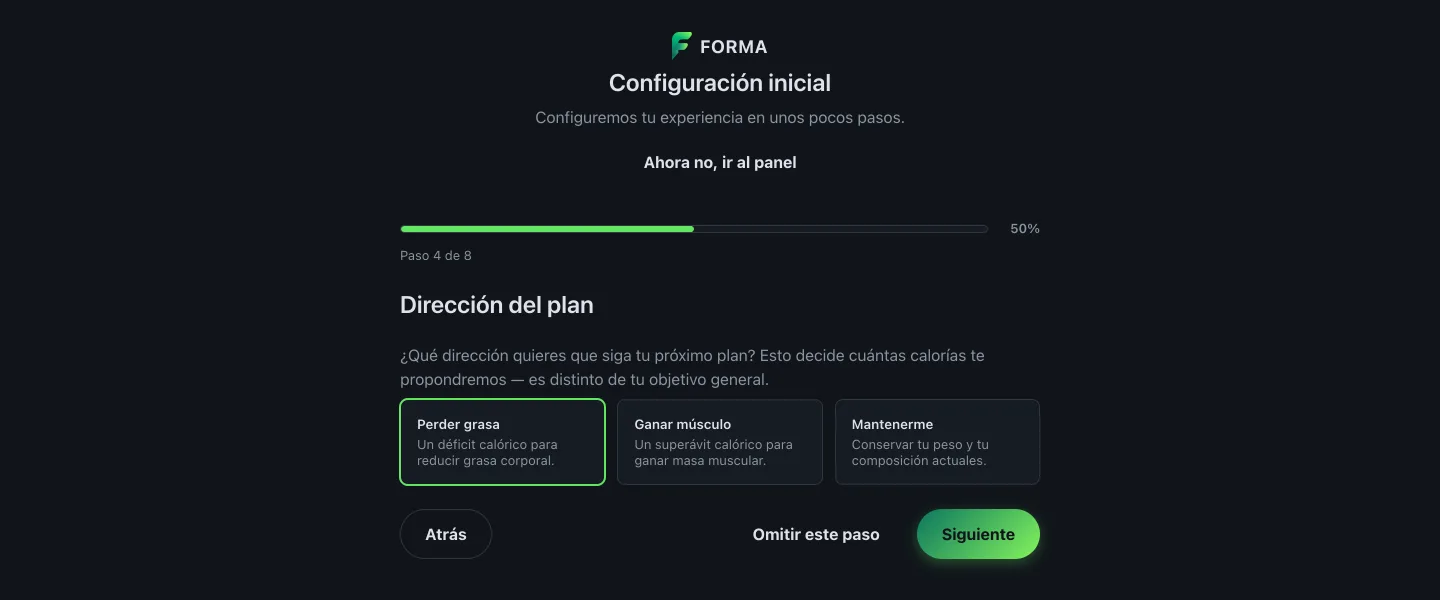
The plan generator's original design had a decision that seemed reasonable to me when I wrote it: infer the direction of the plan from the user's general goal. If someone had said their goal was "body composition", the system assumed fat loss and applied a 20% deficit.
Diego rejected it, and he was right. "Body composition" is an equally honest answer for someone who wants to lose fat and for someone who wants to gain muscle. A silent 20% deficit applied to the wrong person isn't a product detail: it's a claim about what somebody should eat, made without asking.
The wizard now asks explicitly, in a step of its own. And along the way a free-text field disappeared — "foods you'd rather avoid" — which was exactly where people write their allergies and their medical conditions. GDPR Article 9 special-category data, collected in a text box nobody ever read.
H2 says PostgreSQL, and it isn't PostgreSQL
The project's 62 migrations were validated on every pull request against H2 in PostgreSQL compatibility mode. That mode is a compatibility layer, not Postgres, and it had already bent real design decisions: there's a partial-unique-index trick in the schema that exists solely because H2 won't parse the syntax Postgres accepts.
Which means: no migration in this repository had ever been verified against the database that runs in production before being deployed.
The fix was obvious: a separate CI job, a postgres:17-alpine container, and
apply all 62 migrations against it. I built it, it went green, and that's where
it got interesting.
The one technical dive in this post
A Gradle Test task that matches no tests does not fail. It finishes
successfully, silently, in a couple of seconds. Filter by a JUnit tag nobody
uses and the build is still green.
The first thing I reached for was the option that looks purpose-built for this:
test {
  filter { failOnNoMatchingTests = true }
}
It doesn't help. That property governs filters by name (--tests,
includeTestsMatching), not JUnit Platform's includeTags. I checked it by
pointing includeTags at a tag that doesn't exist, on Gradle 8.14.1: still
BUILD SUCCESSFUL. And failOnNoDiscoveredTests doesn't exist in that version.
What does work is counting and breaking:
tasks.register('postgresTest', Test) {
    useJUnitPlatform {
        includeTags 'postgres'
    }

    def executedTests = new java.util.concurrent.atomic.AtomicInteger()
    afterTest { desc, result -> executedTests.incrementAndGet() }
    doLast {
        if (executedTests.get() == 0) {
            throw new GradleException(
                'postgresTest ran zero tests: the `postgres` tag matched nothing, ' +
                'so not a single migration was verified against real PostgreSQL.')
        }
    }

    // Without this the CI log shows only `BUILD SUCCESSFUL`, and a reader
    // cannot tell a real 62-migration run from a no-op.
    testLogging {
        showStandardStreams = true
        events 'passed', 'failed'
    }
}
Two ideas: the job counts what it runs and breaks if that's zero, and the log prints how many migrations it applied and which one was last. A job that verifies something has to be able to prove it in its own log. If reading the output can't tell "verified 62 migrations" apart from "did nothing", that job isn't a guarantee: it's a green ornament.
The plan the agent claims isn't the plan that adds up
This is the same mistake, made by an AI instead of by me.
When a model generates a nutrition plan it returns the meals and the day's calorie and macro totals. Those totals are a claim it makes. The repository contains a real LLM-generated diet, imported weeks ago, in which the calories the model itself declares fall short by between 379 and 702 kcal every day compared to what its own food list adds up to. Every single day. Protein, curiously, checks out.
The spec had said from the start that the backend must recalculate and validate before saving anything, "because the AI may report an incorrect total". It had never been implemented.
The hard part wasn't deciding how to recalculate — it was deciding what to do with the difference. And the right answer is: nothing. The auditor reports and never corrects the declared value, because the distance between declared and calculated is the evidence that the model got it wrong. Overwrite it and you delete the only proof you had.
A domain isn't migrated until the login works
The domain change looked like the boring task of the week. It wasn't.
An OAuth redirect_uri is an exact match against what's registered in the
provider's console. Changing the domain in code without registering the new URL
— first, and without removing the old one — takes the login down in the
window between deploy and registration. And it had to be checked across four
providers and two applications, with Akademia's OAuth client hiding in a
different Google Cloud project from Forma's.
What we did was not read the configuration and call it good. We started the real flow for both applications, followed the redirect all the way to Google, and confirmed each one reached its login screen with the correct client. That's the difference between reviewing a list of URLs and verifying a flow.
On Sunday three applications went down. None of them were down
With the domains now behind Cloudflare's proxy, on Sunday all three apps stopped responding from the home wifi. At the same time.
Nothing was broken. The containers were healthy, nginx validated its config, all three upstreams returned 200, and everything loaded fine over mobile data. The failure sat between the ISP and Cloudflare's anycast range: neither the laptop, nor the wired machine, nor the router itself could reach those two IPs, while the rest of the internet was perfectly fine.
Akademia gave the clean comparison: its old domain, still pointing straight at the public IP, worked from home; the new one, behind the edge, didn't. A symptom that looked like "everything is down" was, once again, an unverified claim — mine this time.
How it turned out
The first-run wizard now asks for the plan's direction in a step of its own, with the three options and what each one means spelled out underneath. Nothing is inferred:
And when you finish, the request actually goes out to the backend, which freezes it with the calories already computed:

For an account with no plan, the dashboard no longer promises anything. The menu widget says there are no meals for today, and the notice at the bottom says exactly what is going on, with a button to the only plan creator that actually works inside the app:
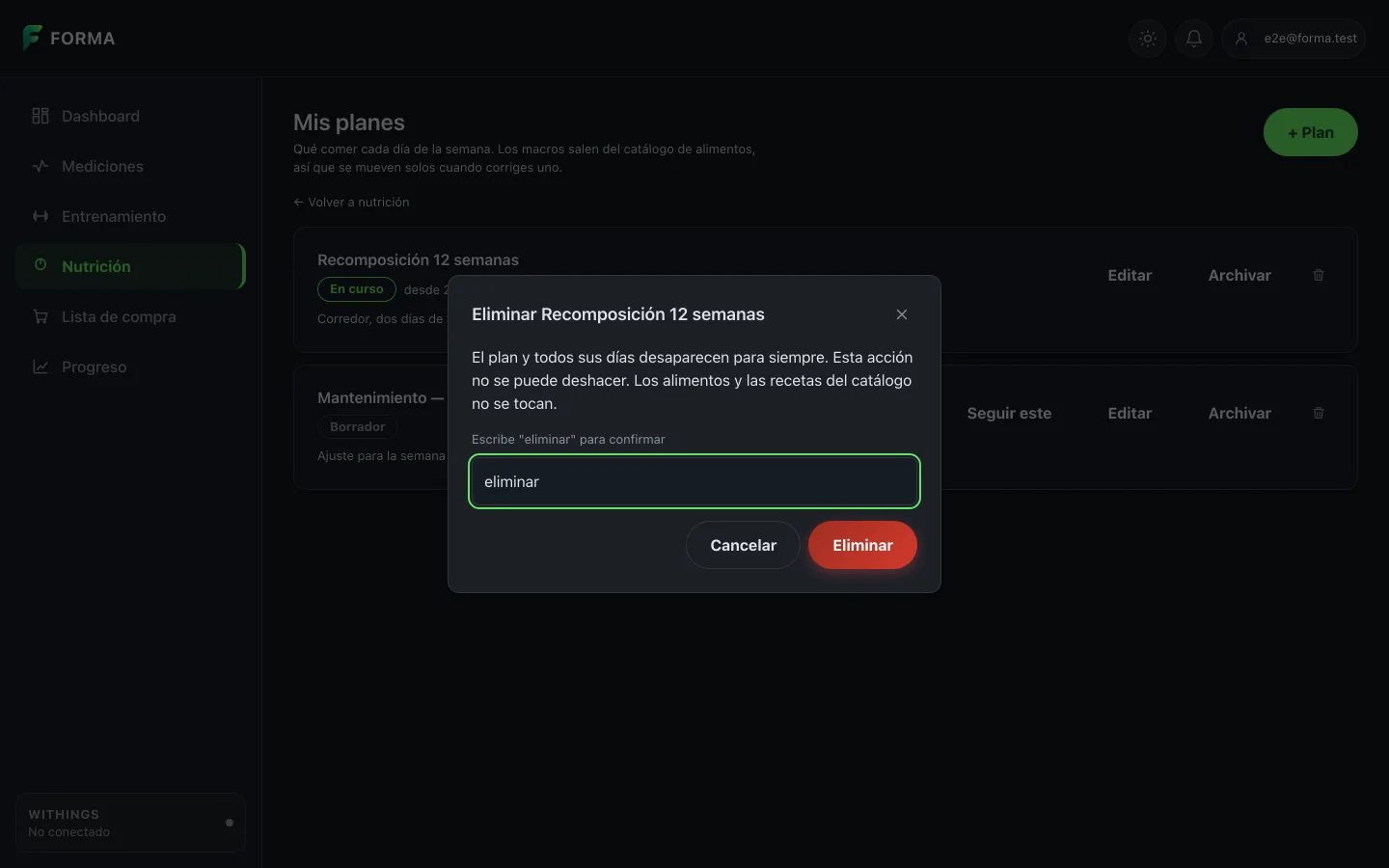
And deleting a plan — which now also releases the request that produced it — makes you type the word before the button will let you through:
Beyond the wizard, the week left the plan's full skeleton in place: a table that freezes the input data at the moment you ask for a plan (the calories it computes are the ones the person will see, not the ones the formula would give tomorrow), an endpoint that rejects with a clean 409 if you already have an open request, a neutral port towards the AI agent with its adapter and fixtures, and a twelve-week programme modelled as three four-week blocks instead of 84 days generated in one go.
And Forma's README went from being the repo's kick-off note to a proper front page with 21 screenshots and, above all, a section that says out loud what the application does not do: that Strava, Garmin and Apple Health don't exist, that the AI agent is wired up but inert without its environment variable, and that the app starts empty by design. Staying quiet about it doesn't avoid the disappointment, it just postpones it to the first issue.
What didn't go well
- The Postgres job went green without running anything. I found it reading the log out of curiosity, not because it failed. Had I not looked, I'd have a job today that verifies nothing and that I trust.
- One test wiped another test's seed data. All the integration tests share a
single in-memory H2 database for the whole process, so one class that emptied
tables made another fail depending on alphabetical order. My first fix was
a
@DirtiesContextthat couldn't possibly work — a fresh context reuses the same named database — and it had to be redone. - Google sign-in didn't work first time. Behind the double proxy it
generated the
redirect_uriover HTTP instead of HTTPS, and on localhost it dropped the port along the way. - The tool we document the project with was serving two broken screens. The fixture-driven dev mode painted "NaN €" in the shopping list and an error on the plans page. It had been like that for a while.
- I wrote a CHECK that was too clever. I pinned block length to exactly 4 weeks in the schema. That doesn't validate an input: it forbids a product change. It had to be relaxed to a range in the same PR.
- Dispatching to the agent never started. Slice 6 is still pending: today the request gets stored and there's still nobody on the other side.
What I'm taking away
A claim nobody checks is technical debt with interest. The dashboard banner, the README, H2's PostgreSQL mode, the calories the model declares and my own "everything is down" are exactly the same bug wearing five different faces. They don't fail: they're simply not true, and since nothing contradicts them, they stay.
Two rules came out of it, and I've written both down:
If a value can be claimed by whoever produced it, recalculate it — and store the difference, don't correct it. The discrepancy is the evidence.
And a CHECK should rule out the impossible, not the undecided. Freezing a product decision into the schema turns a change of mind into a migration.
Next week: dispatching to the agent and ingesting the plan it returns, with the auditor's report stored alongside the request. And starting the second entrance to the building — the one for people who ask for a plan before they have an account.
The week in numbers
akademia and forma moved under backendtothefuture.com, alongside tokenmeter
branch-pr · chained-pr · work-unit-commits · recap
A note on the screenshots: they are taken against the application at the last commit of the week, with sample data and no real backend. Nothing you see here is real health data.