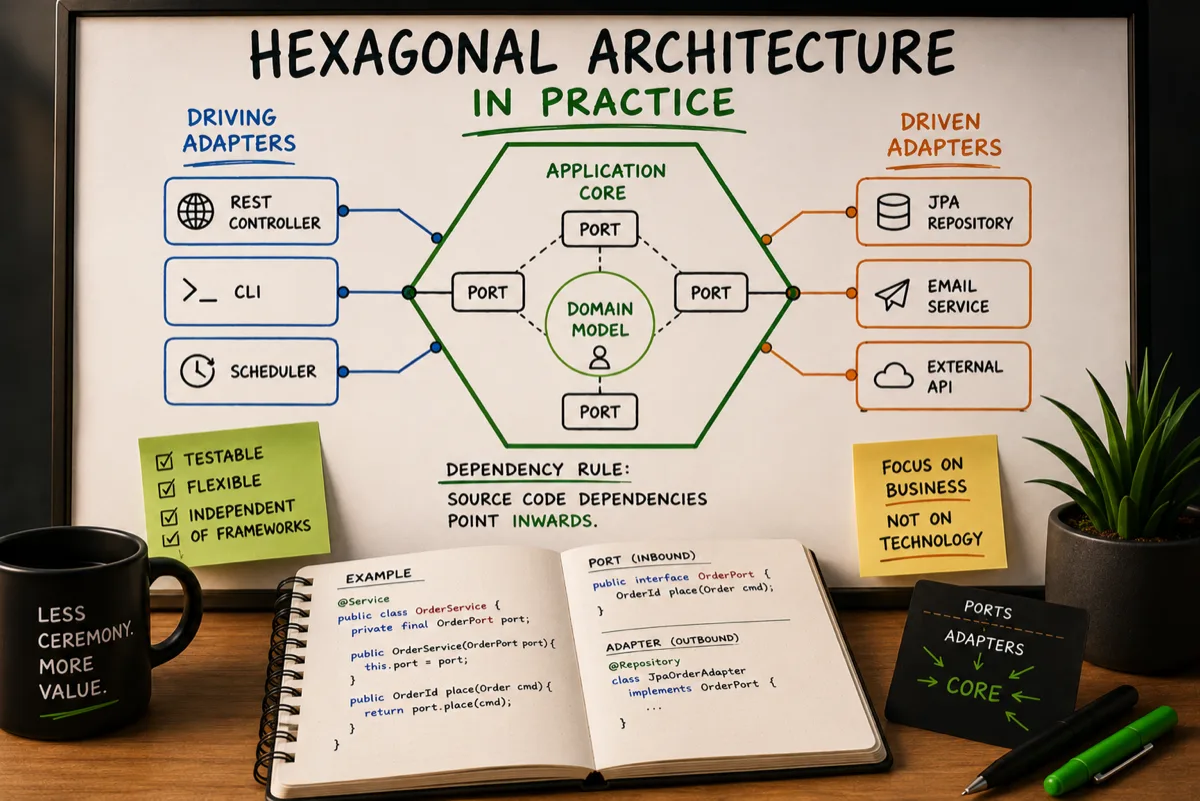
Hexagonal Architecture in Spring Boot: ports & adapters
How I apply ports & adapters in real Spring Boot services — without the ceremony.
The problem with layered architecture
We've all seen it: a Controller that calls a Service that calls a Repository. Clean, predictable — until the day you need to replace your ORM, expose the same use case via a message queue, or test business logic without spinning up a database.
Layered architecture couples your domain to infrastructure. Hexagonal architecture doesn't.
The core idea
Your application has a domain (business logic) at the centre. Everything else — HTTP, databases, queues, external APIs — is an adapter that speaks to the domain through a port (a Java interface).
Inbound adapters  →  [Ports]  →  Domain  →  [Ports]  →  Outbound adapters
(REST, gRPC, CLI)                                         (JPA, Kafka, HTTP)
The domain knows nothing about Spring, JPA, or HTTP. It just executes business rules.
A concrete example
Imagine a CreateOrder use case:
// Port (inbound)
public interface CreateOrderUseCase {
    OrderId execute(CreateOrderCommand command);
}

// Domain service (lives in the hexagon)
@Component
public class CreateOrderService implements CreateOrderUseCase {
    private final OrderRepository orders; // outbound port
    private final EventPublisher events;  // outbound port

    @Override
    public OrderId execute(CreateOrderCommand command) {
        var order = Order.create(command.customerId(), command.items());
        orders.save(order);
        events.publish(new OrderCreated(order.id()));
        return order.id();
    }
}

// Outbound port
public interface OrderRepository {
    void save(Order order);
}

// Adapter (infrastructure)
@Repository
public class JpaOrderRepository implements OrderRepository {
    private final SpringDataOrderRepository jpa;
    // ...
}
What you gain
- Testability: test
CreateOrderServicewith a fakeOrderRepository— no DB needed. - Swappability: replace JPA with jOOQ, or add a Kafka listener as a new inbound adapter, without touching the domain.
- Clarity: the domain package is pure Java. No
@Entity, no@RestController, no surprises.
The trade-off
More files upfront. If you're building a CRUD endpoint with no real business logic, this is overkill. I reach for hexagonal architecture when the domain has invariants worth protecting — not for every microservice.
Where I draw the line
In practice, I don't enforce hexagonal purity at every boundary. I apply it selectively to the parts of the system that carry real business weight. The goal is isolation of the core, not architectural ceremony.
Start small: identify one use case, extract its port, write a unit test. You'll feel the benefit immediately.