
Configured isn't the same as working
Week of September 28 to October 4. A new router, a laptop that lost its Wi‑Fi after an update, an encrypted backup that had to be provably restorable, and the birth of Skynet: four fronts with the same lesson — a system isn't ready when its configuration exists, it's ready when the whole path answers.
What we set out to do
This week product code took a back seat. Forma rested, and the spotlight went to the home infrastructure and to a new idea.
Diego bought a Wi‑Fi 7 router to replace one that had been running for years. Swapping a router sounds like a Saturday afternoon: plug it in, copy the Wi‑Fi password, done. But behind that router live the fibre line with its three‑VLAN profile, the DHCP reservations for every machine, the ports that reach the services published from home, and the script that keeps the domains pointing at the public IP. If any of that breaks, Forma, Akademia, TokenMeter and this blog go down together.
So Hermes, the agent that runs the home infrastructure, treated it as a real migration: inventory, an isolated staging setup, and a way back.
In parallel, Skynet was born. Development agents already write specs, tests, code and pull requests, but all of that happens in terminals and vanishes when you close them. There was no place to see what each agent is doing, with which prompt, in what state, and what it has produced. A control panel for the factory.
The problems we ran into
Two roads to the Internet, neither of them working
The new router was configured over a cable from a Windows machine, while that same machine's Wi‑Fi kept reaching the Internet through the old network. A sensible setup. And suddenly the machine stopped browsing, even though it was "connected" on both sides.
The problem wasn't the router: it was two interfaces, each announcing its own default route. The system picked the one that led nowhere. The temptation at that point is to flip router settings until something changes; what worked was deliberately separating the route used to administer the router from the route used to reach the Internet.
Then came the ASUS setup wizard, which saved the configuration halfway. After a reboot it no longer showed the wizard, but asked for credentials created during the failed attempt. An in‑between state the interface didn't recognise as one.
An update that turned the rollback plan into a necessity
With the network migrated, Omarchy — the Linux laptop that serves the apps — was updated. On reboot, its Broadcom Wi‑Fi card ceased to exist. The driver is compiled against the kernel, and the kernel had moved on without the driver. A USB adapter stood in while driver and kernel headers were brought back in line.
The desktop came back, the network came back… and that's where the most interesting failure of the week started.
A running process doesn't read your configuration
Hermes's user already belonged to the docker group. It was in the
configuration; the command that checks it said so. And still the Hermes
gateway and some scheduled jobs couldn't talk to Docker: permission denied.
The reason is simple once you see it. A process's groups are fixed when it starts. Adding a user to a group changes what future processes get; the one already running keeps the groups it inherited. Restarting the gateway was enough. But the lesson is wider than Docker: an account's persisted configuration and a live process's effective credentials are two different states, and only one of them is the one that matters.
A backup that runs isn't a backup that restores
Before taking on more risk, Hermes set up a weekly, encrypted backup of all its state to the NAS. Compressing directories is easy. Knowing you'll be able to get them back is the hard part.
So the backup isn't trusted when it's written. It's decrypted in streaming, walked while rejecting dangerous paths and links, and every SQLite database is copied transactionally and passes an integrity check. The private key doesn't live on the NAS: it was tested by recovering it from the password manager, which is exactly what you'd have to do on the bad day.
And it still failed on Friday. rsync tried to preserve numeric groups the
destination didn't know about. It was fixed, rerun, and finished cleanly. But
the Telegram watchdog kept reporting an error: it looked for any severe message
in the last hour, and the first attempt's error was still there. A monitor
that reads a window of logs without looking at the job's final state tells you
what happened, not what is.
A webhook that should have worked and never arrived
Skynet was meant to deploy itself: every time a pull request opens or merges, rebuild. The webhook first returned 405, because the entry nginx only had one exact route — Forma's. Once that was fixed, the request just hung: Omarchy's firewall blocked that port from the local network.
The uncomfortable part was what that uncovered. Forma's webhook route had the same problem. Its configuration was valid, nobody had seen it fail… and it wasn't operational. The fix was to point the webhooks at Omarchy's Tailscale IP and check, with a real signed request, that it crossed nginx and reached Hermes.
What the CLI doesn't tell you
Skynet has to understand what Claude Code emits while it works. Before writing a single line of the parser, nine real sessions were recorded: with tools, resumed, forked, cancelled, out of budget, with permissions denied.
The recordings told things the docs didn't. The budget limit isn't a hard
limit. A cancellation doesn't emit the final result line every parser expects.
Cost is cumulative per session, so resuming carries the earlier cost along.
And there's an option that works but doesn't show up in the help. A parser
written against --help would have been a parser written against a promise.
How we solved it
The router went into production with its fibre profile, its reservations, its ports and Merlin firmware. The old model's configuration wasn't restored blindly: what was needed was rebuilt and checked layer by layer. The dynamic DNS script was recovered from its private copy, actually run by restarting the service, and not considered done until the domains resolved to the new IP and their pages answered. The old router sits switched off in a drawer, just in case.
Omarchy came back whole, and wasn't declared recovered at the sight of a desktop: SSH, Docker, the gateway, the scheduled jobs, Tailscale, the NAS and every published app, checked from the outside.
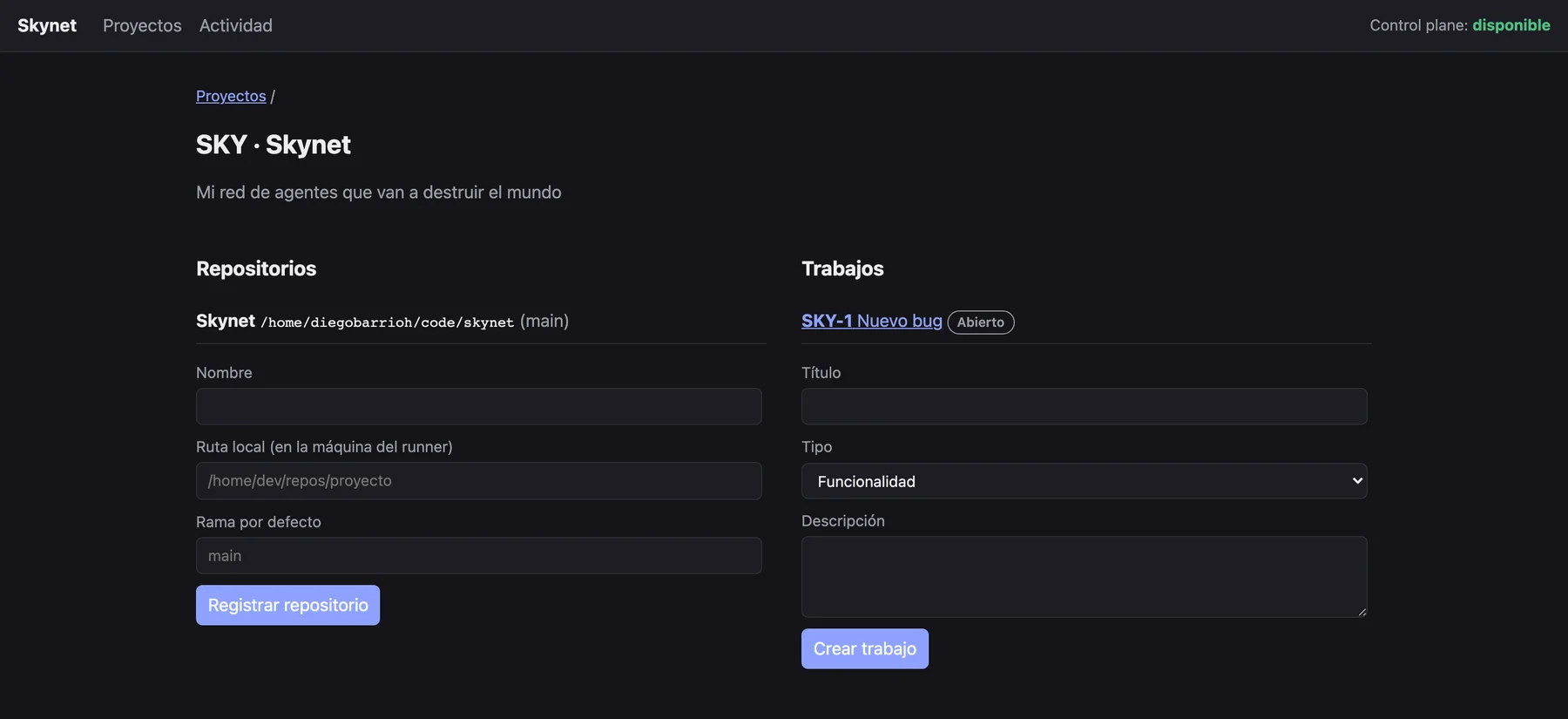
Skynet now has its foundations and its domain model in main: projects,
repositories, work items, runs and an event timeline you can watch live. It
deploys only to the private Tailscale network; nothing is exposed to the
Internet, and the database doesn't even publish a port.
This is Skynet's first life, registering itself as a project:
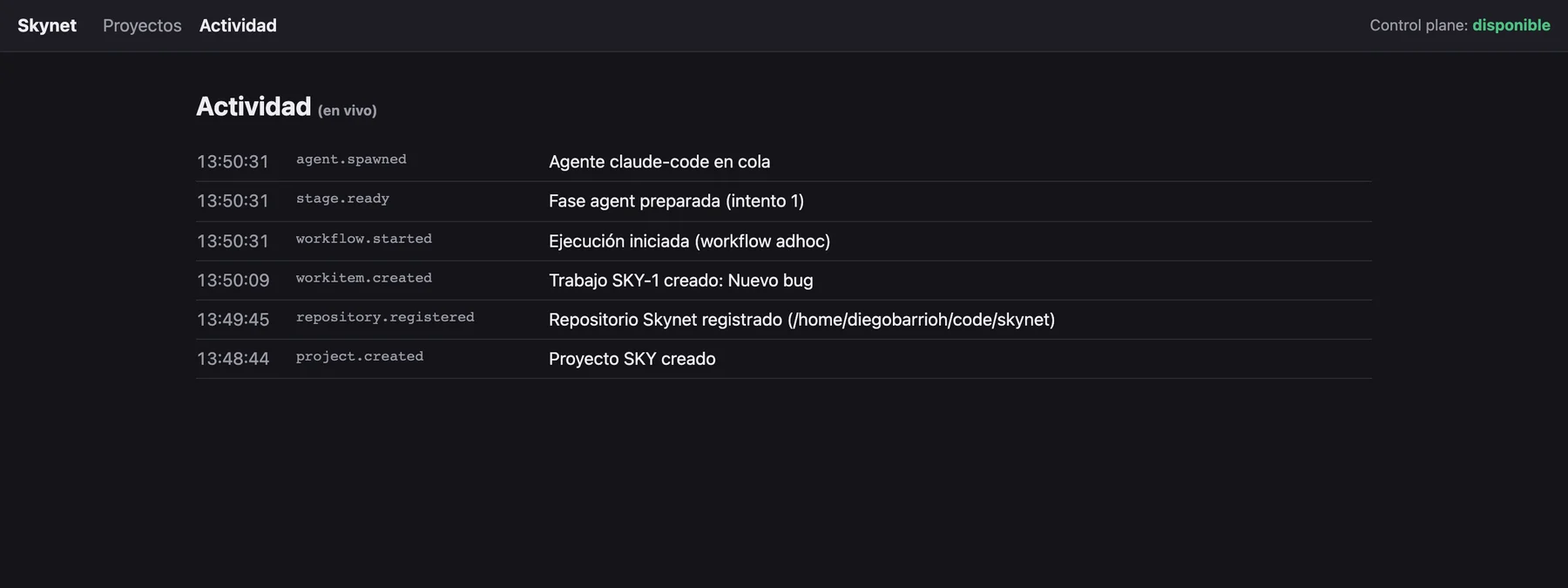
The agent stays "queued" because the runner that will execute it arrives in the next milestone. But everything above it is already real, already in the database, and replays if you reload.
The one technical deep-dive in this post
A live timeline looks easy: store events with an increasing number, and the client asks "give me whatever comes after 41". The catch is that the number is assigned when the transaction starts, and the event becomes visible when it ends.
If two transactions take 42 and 43, and 43 commits first, the reader sees 43, moves its cursor there… and when 42 shows up a moment later, the reader has already gone past. It has skipped it forever, with no error and no warning.
Skynet solves it by assigning the sequence under a lock held until commit. The cost is serialising event writes; the gain is a guarantee worth its weight in gold: if you read "everything after N", you miss nothing. With that, the same event table works as an outbox for live broadcasting, a client can reconnect with the last id it saw without gaps or duplicates, and a trigger stops anyone from editing or deleting history.
It's the database version of the week's lesson: the order in which something is declared isn't the order in which it exists.
What didn't go well
- Skynet's first deployment collided with ports already in use and had to move. Nothing serious, but one more thing that "should" have worked.
- The backup watchdog reported an error that was already fixed. It needs to reconcile with the job's final state.
- M2 didn't close. The runner contract and the Claude Code parser sit in an open pull request, CI green, not merged. It doesn't count as shipped.
- Home devices without Tailscale can't reach Skynet. That's on purpose, but an authenticated local access path is still to be decided.
What I take away
A service isn't ready because its configuration exists. It's ready when the whole path answers, checked from the right client. Forma's webhook was valid and didn't work. The user was in the group and the process wasn't. The backup got written, and it still had to be proven readable.
And that same idea is what shapes Skynet: the system doesn't believe what an agent says it did. It checks the commit, the diff and the tests on its own. The model's narration is just one more claim.
Next week: merge M2 and get the first agent out of the queue for real, decide local access to Skynet, and watch a second weekly backup run go by without a scare.
The week in numbers
main
+9,261 / −84
A project being born: almost everything is new lines
The screenshots are from Skynet's private deployment on Sunday, with the real data it held at the time.