
Building an orchestrator that doesn't trust its agents
October 5 to 11. Skynet, the coding-agent orchestrator, closed its first phase, got a brand-new interface and started running workflows, and every verification layer caught something the previous one had waved through: CI included.
What we set out to do
Last week Skynet was born: the orchestrator Diego is building so that
several coding agents can plan, implement, review and validate software
changes on their own, with a person supervising rather than typing. It ended
the week with its foundations on main and an agent waiting in a queue for a
runner that didn't exist yet.
This week had one clear goal: close the first phase. Get the runner to execute real agents, make them resumable, retryable and forkable, have every run leave evidence of what it did, and put all of it behind a login. What wasn't in the plan arrived mid-week: Diego decided that, before adding anything else, the whole interface had to be rebuilt. And on Saturday, with all of that closed, the second phase began: workflows defined in YAML that Skynet runs step by step.
There was one more change, less visible and more important. Everything was built from Claude Desktop, in working threads, and Hermes, the agent that runs the home infrastructure, started deploying and testing every pull request on its own. The week's loop became: Claude writes and opens the PR, Hermes deploys it and runs its test guide, Diego tries it locally and says "all good, merge and keep going". That phrase showed up more than thirty times.
The problems we ran into
Three bugs under a green CI
On Tuesday, before merging the PR that taught the runner to fork sessions, Claude gave its own code one last review. CI was green and nobody had left a comment. Three bugs turned up anyway: files that weren't UTF-8 text got corrupted when copied into the forked branch, symbolic links were followed outside the repository, and a fork that failed halfway left an orphaned branch and working directory behind.
The test suite would have caught none of them, because none of those cases were in it. Green said that what had been tested worked. It said nothing about what hadn't.
A runner that said "yes" to everything
That same morning Diego tried resuming a session locally and the new reply never arrived. The agent sat at "Starting" forever. It was Diego who found the cause: the runner that was running was the previous binary, built before resuming existed.
Rebuilding fixed it, but the unsettling part was something else. The old runner had received an order it didn't understand and had acknowledged it. No error, no rejection: a "received" and a hung agent. A system that accepts something it can't do is worse than one that fails, because at least a failure is visible.
A redesign nobody had asked for
On Thursday, with the first phase closed, Diego stopped before starting on workflows. The interface worked, but it was the classic internal tool: grey, dense and hard to read at a glance. Claude studied nineteen agentic workflow tools (Temporal, Prefect, n8n, Langfuse, Dify…) and, since their websites were blocked from the environment, drew its conclusions from their source code. The recommendation was what nearly all of them use: shadcn/ui.
Diego turned it down as too standard. The brief was something with personality: a visual language inspired by gamified learning apps, with very rounded corners, buttons that feel physical, short firm shadows and every state conveyed at once through colour, icon and text. The mockup landed on the first try. The hard part came after: rebuilding every screen without breaking anything that already worked, in eight deliveries over two days.
The engine that waited on itself
On Saturday the first version of the workflow engine failed in CI with something you don't see in a Postgres log every day: deadlocks. The engine decided which stage came next inside the same transaction that recorded the state change, and that decision waited on a run that a worker had locked.
Last week, assigning the event sequence under a lock held until commit was what guaranteed a gap-free timeline. This week showed the price: if a transaction does too much while holding that lock, it ends up waiting on whoever is waiting on it.
An editor you couldn't touch
On Sunday morning, before approving command nodes, Diego tried the workflow editor from an iPhone. Selecting text, copying and pasting were all impossible. Monaco, the VS Code editor Skynet uses on the web, doesn't support touch screens and swallows the taps. No test would have found it, because no test runs in mobile Safari with a finger.
Green that wasn't acceptance
And the last one. The conditional-nodes PR ended the week with its five GitHub checks green: Java, Vite, Playwright, Docker Compose and SonarCloud. Hermes deployed it, ran its test guide and found that a web test couldn't locate a link that should have been there. 130 out of 131.
CI said the PR was ready. It wasn't.
How we solved it
The three fork bugs were fixed with one test each before merging. The runner that acknowledged what it didn't understand became a rule: an agent that misses two heartbeats moves to "Failed", and the command that brings Skynet up always rebuilds the runner from the same revision as the API.
The first phase closed with the thing that makes it useful: the runner uploads
the prompt, logs, commits and diff of every invocation, and runs
verifications on its own. The web tells apart what the agent says it did
from what the system has checked. To test all of that without spending
tokens there is fake-claude, an executable that replays recorded Claude Code
sessions (success, cancellation, budget exceeded, permission denied) and can
even edit files and make real commits.
The new interface shipped in full: navigation, dashboard, a three-panel run view (steps, activity and inspector) resizable from the keyboard, customisable colours with a contrast check, archiving and deleting without losing history, and the visual identity Diego designed for Skynet.
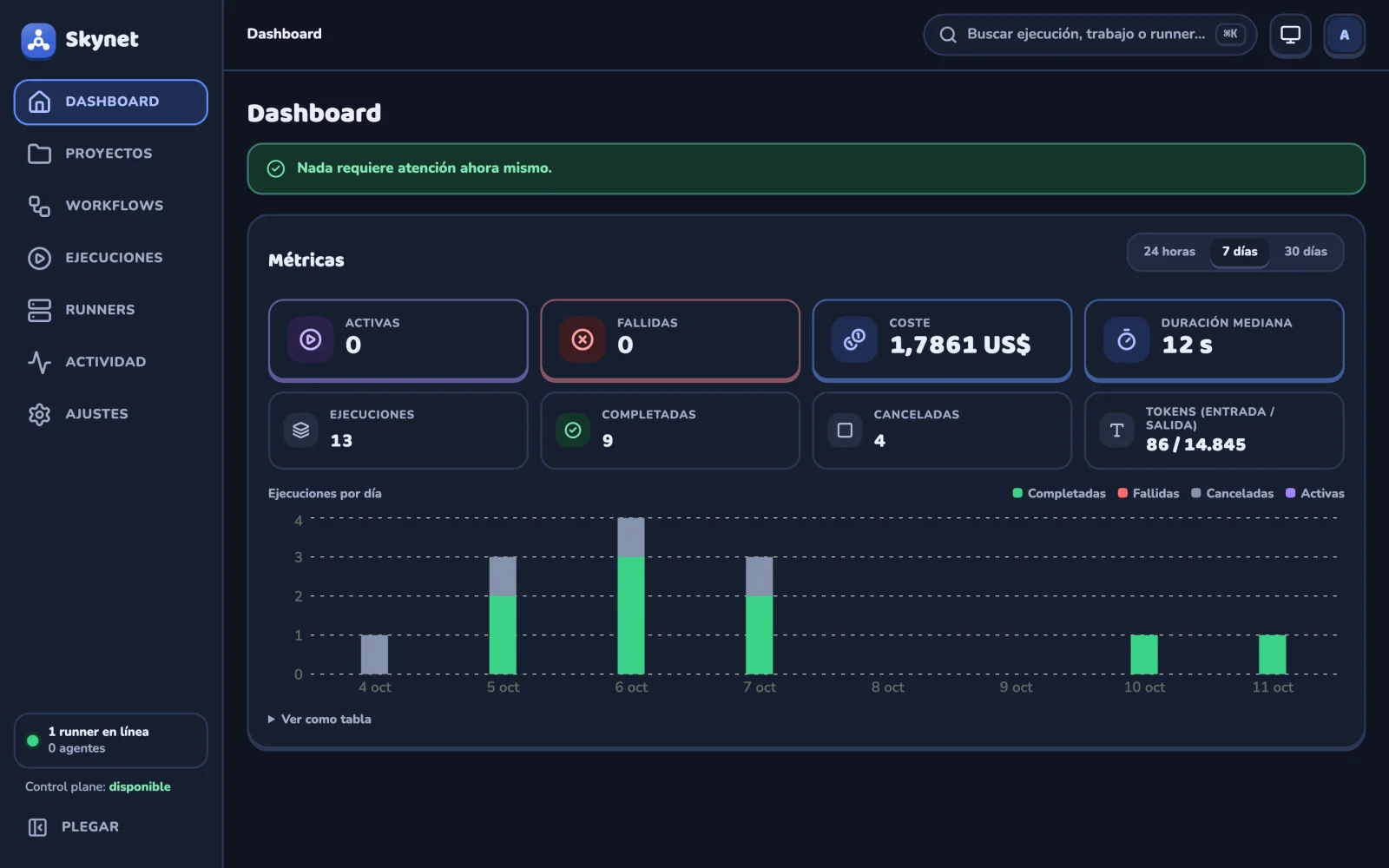
The dashboard in the new visual language: cards with depth, states shown by colour, icon and text, and the first thing you read is whether anything needs attention.
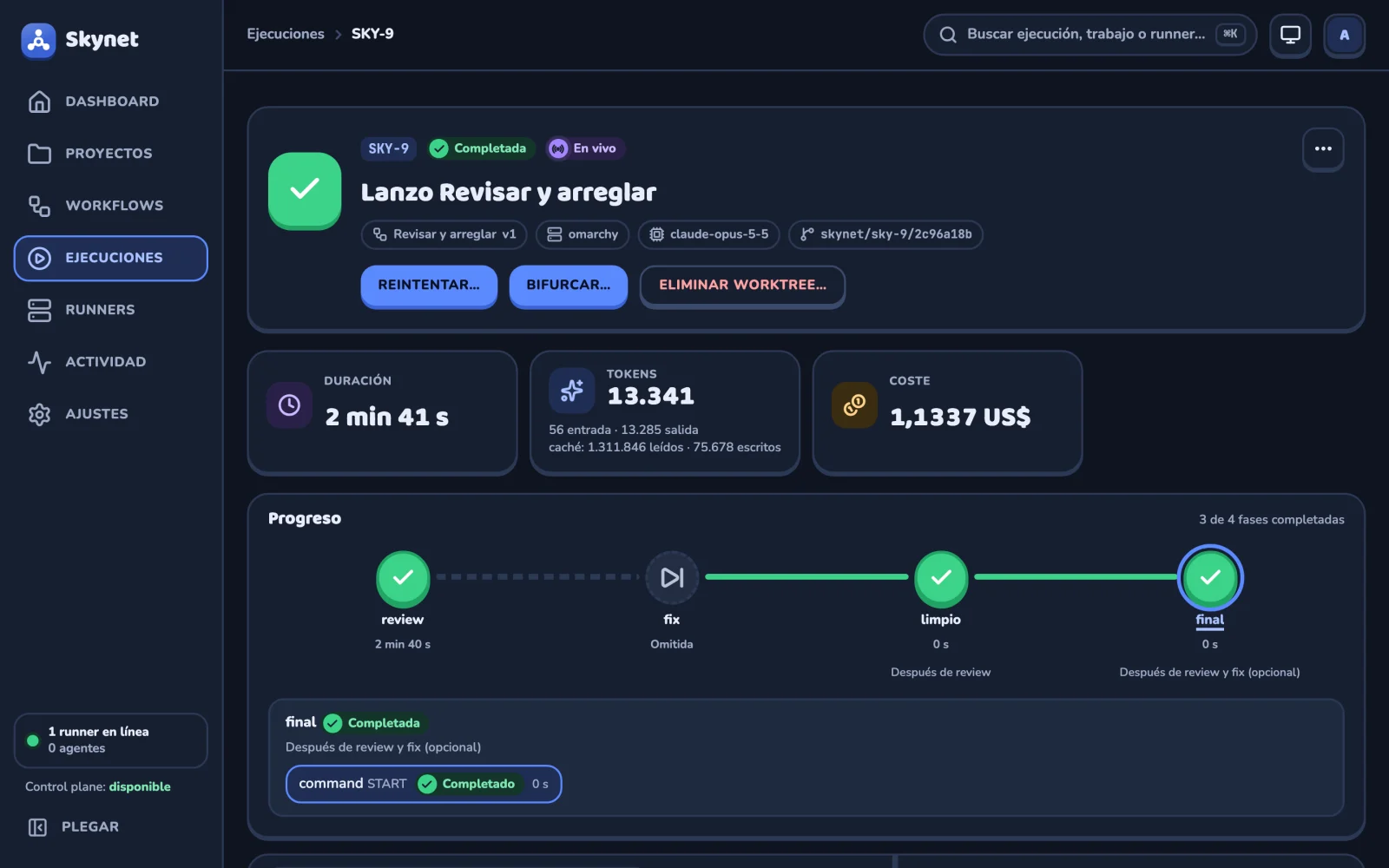
A run of a four-stage workflow, launched while Hermes was testing the
still-unmerged conditions PR. The fix stage is skipped because the review
found nothing blocking, and Skynet shows it as a skip, not a failure.
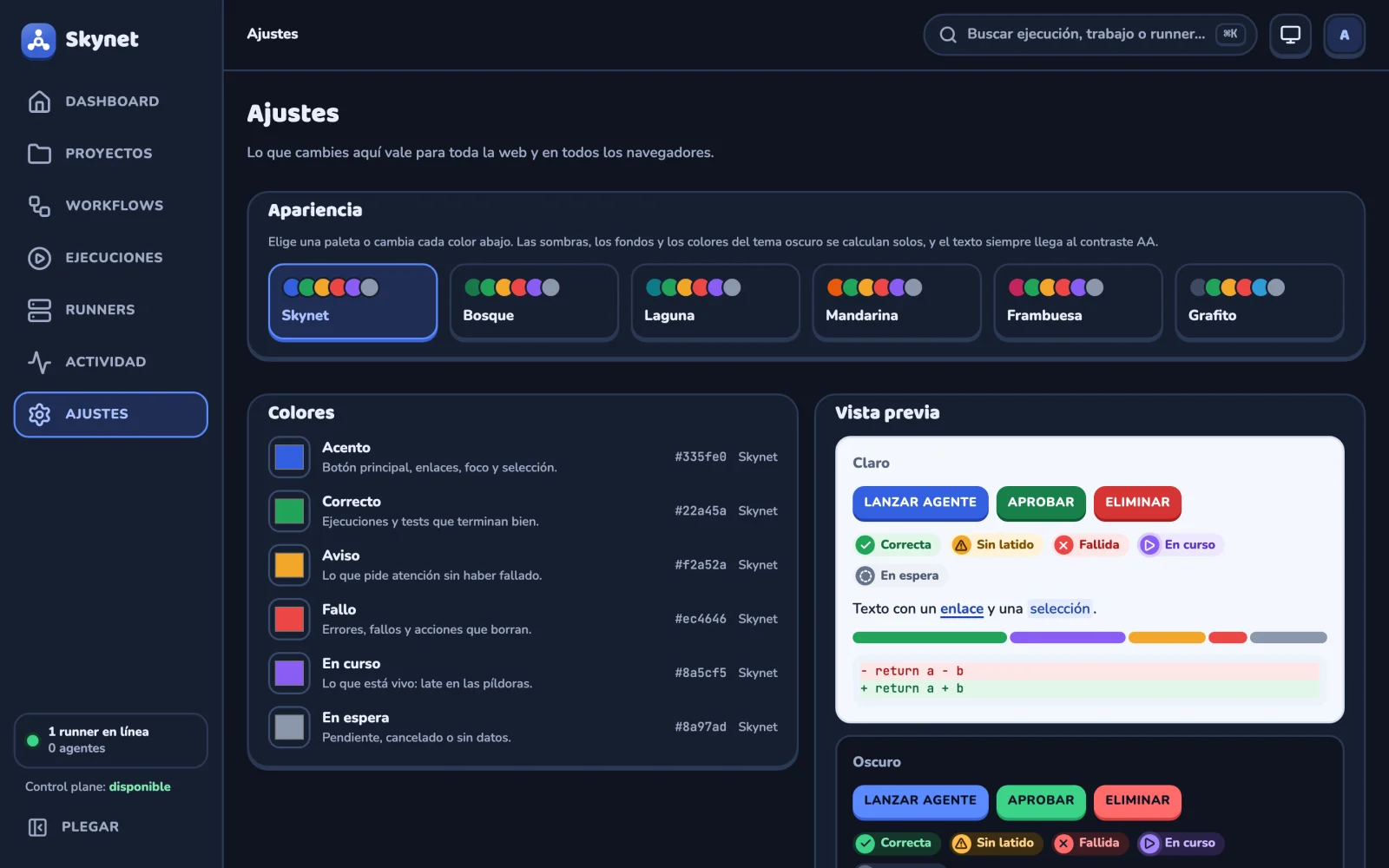
Colours are picked per role and everything else is derived, in both themes, checking that text always reaches AA contrast.
The engine stopped deciding the next stage inside the state-change transaction: the worker does it now, after commit, and the deadlock went away. With that came versioned workflows (draft and published), nodes that run commands, and parallel stages, each in its own working directory. On mobile, the YAML editor swaps Monaco for a native text field with the same validation.
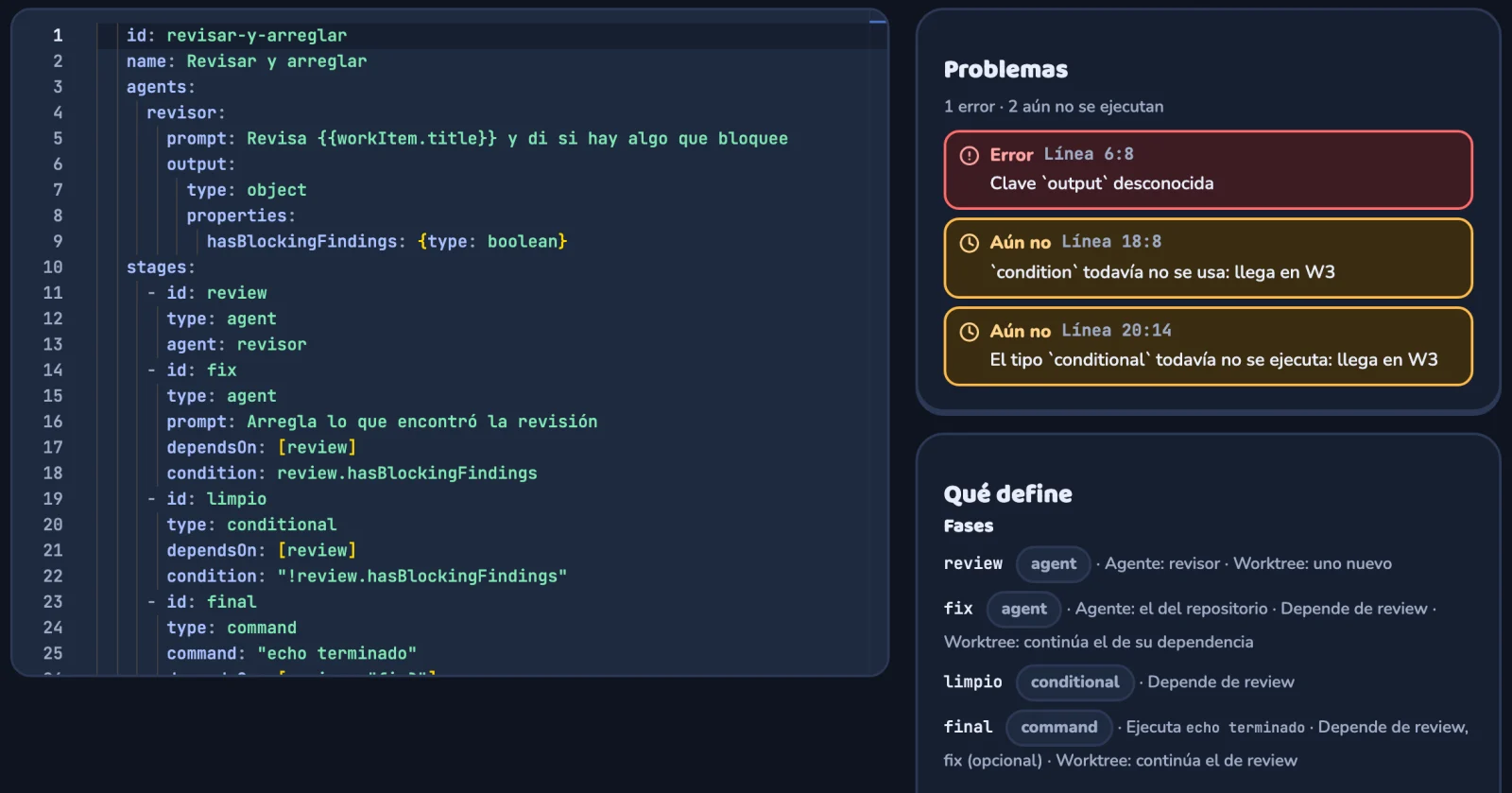
The workflow editor on Sunday's deployment. Look at the yellow notices: the merged version can't run conditions yet, and the editor says so instead of pretending it can.
The conditions PR is still open. It doesn't count as shipped.
The one technical deep-dive in this post
Hermes doesn't test PRs from a list of steps someone maintains on the side.
The PR carries its own acceptance test. Since Wednesday every PR is titled
with its milestone (M6-B - Name) and adds or edits a
docs/tests/probar-m6b.md file with the guide to validate it. When GitHub
reports a PR opened or updated, Hermes checks a contract before touching
anything:
- the PR is open, against
mainand not a draft; - the working directory is clean;
- the SHA is exact, and it's the one being deployed;
- the milestone matches the title;
- and the PR adds or edits its own
probar-*.md.
Only then does it rebuild the containers, rebuild the runner from that same revision, run the guide and send the result over Telegram. A passing build is not acceptance; the guide is the acceptance.
Just as important is what the webhook can't do. It doesn't run
git reset --hard or clean a dirty working directory: if it finds changes, it
stops and lists the paths. When a guide asked for something destructive or
tripped the approval policy, Hermes didn't look for a way around it: it
deployed what it could verify, marked acceptance as incomplete and released
the queue. Automation is useful because of how well it's fenced in, not
because of how much it can do.
What didn't go well
- Conditional nodes didn't ship. Green CI, red acceptance.
- SonarCloud was unreachable from Claude Desktop. Three times Diego had to send screenshots, and once Claude changed code for a warning it couldn't see and guessed wrong.
- The GitHub milestones didn't exist. Issues had been linked for days as if they did, until Diego spotted a PR without its milestone.
- The webhook aborted several times for no real reason, on actions that tripped approval or an E2E reaching for the wrong Postgres.
- The weekly quota hit 98 % before resetting on Saturday night. It didn't run out, but nothing was left over.
What I'm taking away
Every verification layer caught something the previous one had waved through. Self-review found bugs under a green CI. Diego's testing found a stale binary and an editor you couldn't touch. Hermes's acceptance found a regression with all five checks green.
A green check is a claim, just like an agent saying "I'm done". Neither is a lie, but neither is proof. Skynet exists precisely so it doesn't believe either without evidence, and this week it started applying that rule to itself.
Next week: fix conditions and close the W3 nodes, prepare the milestone that lets workflows use Codex or Gemini as well as Claude, and cut the webhook's false aborts without loosening a single one of its limits.
The week in numbers
main touches 429 files
Screenshots are from Skynet's private deployment on Sunday the 11th in the morning, with the real data from the week's testing.