
A title prefix is not a deploy policy
Week of November 16–22. Skynet finished its memory, learned to hold a conversation and spent five days on rapid interface changes. The faster the changes came, the clearer it got where the bottleneck was: not in the code, but in deciding what ships on its own.
What we set out to do
Skynet is the orchestrator where several coding agents plan, implement, review and ship changes on their own. Over the last few weeks we taught it to distrust the author and to grade the judge. This week was about something closer to home: getting Skynet to remember what happens in each project, and making it possible to talk to it.
The week came in three stretches, each faster than the one before:
- from Sunday night to Monday morning, finishing the memory: a wiki per project, a context that gets shared out sensibly, and a curator that proposes how to tidy up what piles up;
- Monday to Tuesday, the chat with Skyny, the mascot, which went from drawing to assistant: eight PRs in a little over a day;
- and Wednesday to Sunday, small interface changes, one after another, in a thread literally called "Make small quick changes to the frontend". It took 32 of the week's 56 messages.
The split of work, as usual: Claude writes the PRs in its cloud sessions, Hermes deploys them to the test machine and checks they work, Diego decides what gets merged. And this week Gemini sent its own report again, the first since June: it had spent the week designing Skyny in 3D together with ChatGPT.
The problems we ran into
An assistant that acts can't approve itself
A chat that only answers questions is easy. Diego wanted more: Skyny should be able to launch a workflow, create a job or retry a run from the conversation. And that brings up Skynet's usual question with a new face: who signs off?
The first temptation is to tell the model to ask before acting. But that's an instruction, and instructions get forgotten, misread or skipped. What you need is for it to be unable to, even if it wanted to.
There was another snag, smaller and more revealing. The plan said each chat turn would be an agent run "of kind chat". But that column already meant something else (start, resume, retry, fork), and adding a new value there would have made it ambiguous for everything else. The chat had to come into Skynet through the same door as the judges, not a new one.
The fast loop surfaced every detail
From Wednesday on, the pace changed. Diego looked at the web app on his phone, asked for a tweak, and an hour later was looking at it again. At that pace, things came up that a code review never sees:
- the chat curtain dropped from the top of the page, not from the bar; and on mobile, the text box focused itself and the keyboard popped up halfway through the animation, shoving everything around;
- Skyny showed up in 2D first and then jumped to 3D: the 3D library loads separately, and while it arrived the app painted the flat fallback drawing;
- on iPad, short pages scrolled a little for no reason. The likely cause: a screen height that, on mobile, includes the browser bar.
None of them was hard. All of them were the kind you only see by using the app.
The design lived in another AI's file
On Saturday, Diego brought Claude his Skyny studio: a self-contained HTML file he keeps polishing with Gemini and ChatGPT, with 34 moods, a hat, a face and accessories. He wanted it inside the app.
The studio was on his Mac, out of the agent's reach, and had to be
connected read-only. But the real problem was something else: between
versions, the studio had been rewritten from scratch. It no longer
matched the 3D modules the app had built from the previous version.
Porting it surfaced the bugs a standalone HTML file hides: Skyny came out
too blue because it inherited the flat drawing's colour, one state had
lost its configuration, and in "Git conflict" Skyny went invisible
because a division returned NaN.
Diego asked the question that matters: "what do I have to do when I add new states, or make a version 4.4?". Version 4.4 arrived the next day.
And the bottleneck moved
With small PRs landing every few hours, the real jam showed up. Hermes wasn't deploying the interface PRs: its auto-deploy rule recognised the phase code in the title ("CH-D", "MV-F"), and these didn't have one. On top of that, each one re-ran the full end-to-end test suite, which takes forever, even when it touched nothing those tests cover.
The fix looked obvious, and Diego proposed it as a matter of course: PRs
whose title starts with UI: deploy themselves. A prefix. One line in a
rule.
It wasn't one line.
How we solved it
Skyny proposes, a person confirms
Chat actions became proposals. Skyny has tools to launch, create, cancel, retry or save to memory, but none of them does anything: they leave a pending card that expires in an hour. The person confirms, from the web app, with their own session.
And the key part: the token Skyny talks with can't reach the web app's routes. If it tries, it gets a 403. It isn't asked not to confirm itself: it can't. Whatever Skyny saves to memory goes in unconfirmed, like anything any other agent writes, and each conversation summarises itself when archived or after half an hour of silence.
The chat turn came in as one more role, like the judges, with tight limits: a small model, only Skynet's own tools, at most five minutes and fifty cents per turn.
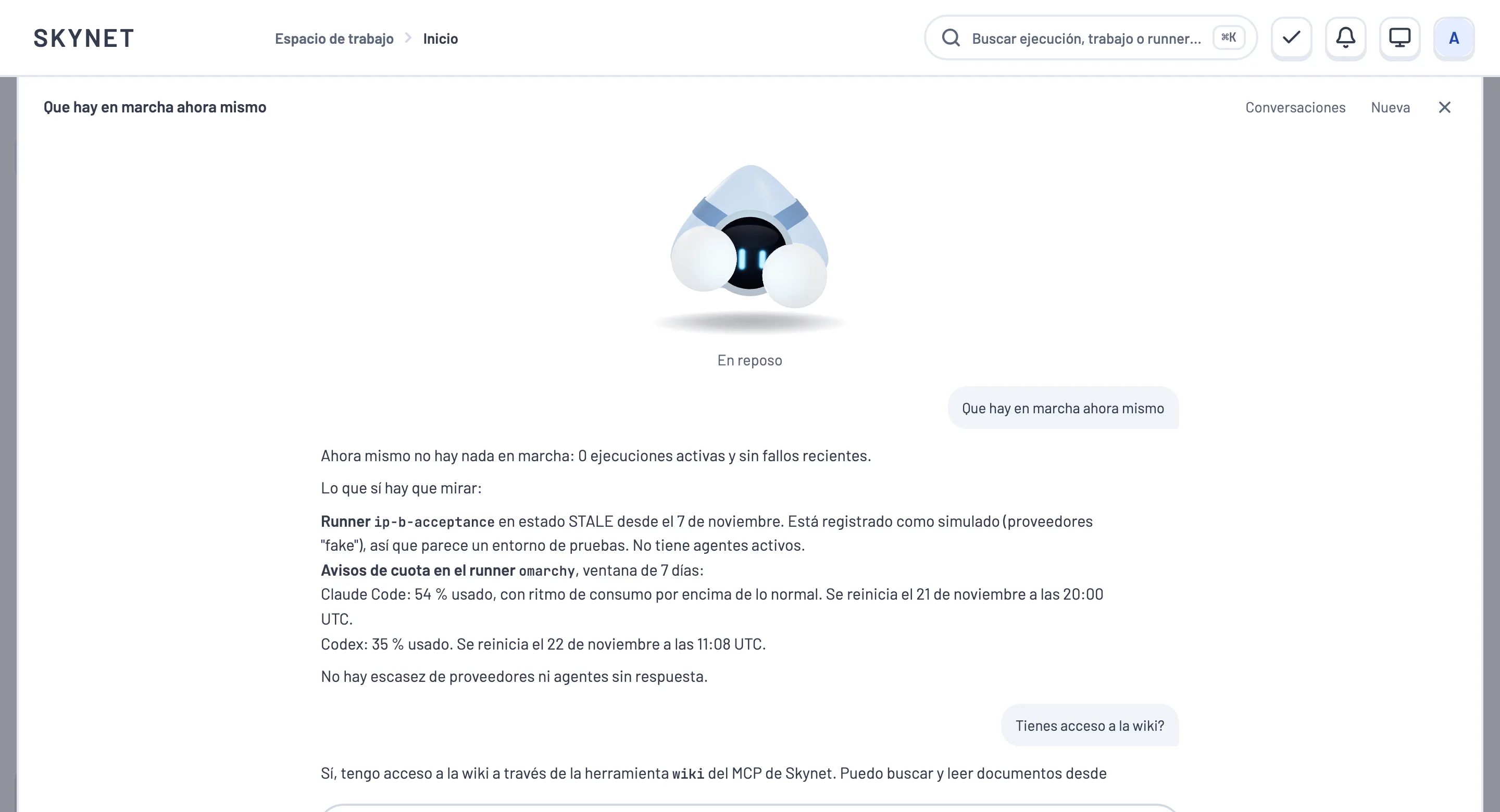
The chat curtain, opened from the logo in the top bar, with a real conversation from Sunday.
The interface, one tweak at a time
The five days of quick changes show across the whole app. The top bar spans the full width and the logo opens the chat. The side menu, which no longer fit, got grouped into tabs. Projects and runners became wide cards, with each agent's version in chips. The curtain now slides out from behind the bar, with no autofocus on mobile, and Skyny's slot fades in while the 3D loads instead of showing the flat drawing.
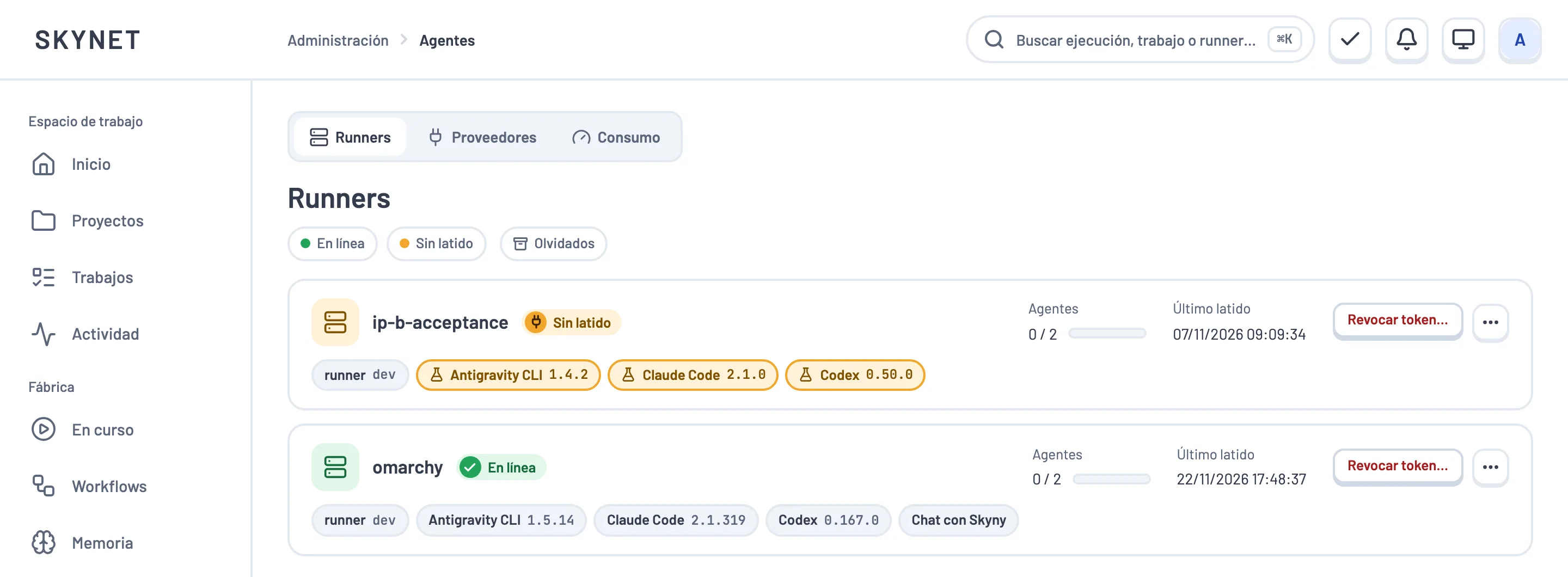
Runners as cards, with tabs. The "Chat con Skyny" chip is what a runner declares to be able to take chat turns.
The Skyny studio was ported whole: instead of patching the 3D modules to look like the new version, the app's engine became the studio's, translated to TypeScript. That way the next version needs no reinterpretation, just another port. The login kept only the essentials: "Entra en Skynet" (enter Skynet), and Skyny waving, with messages scrolling across its screen.
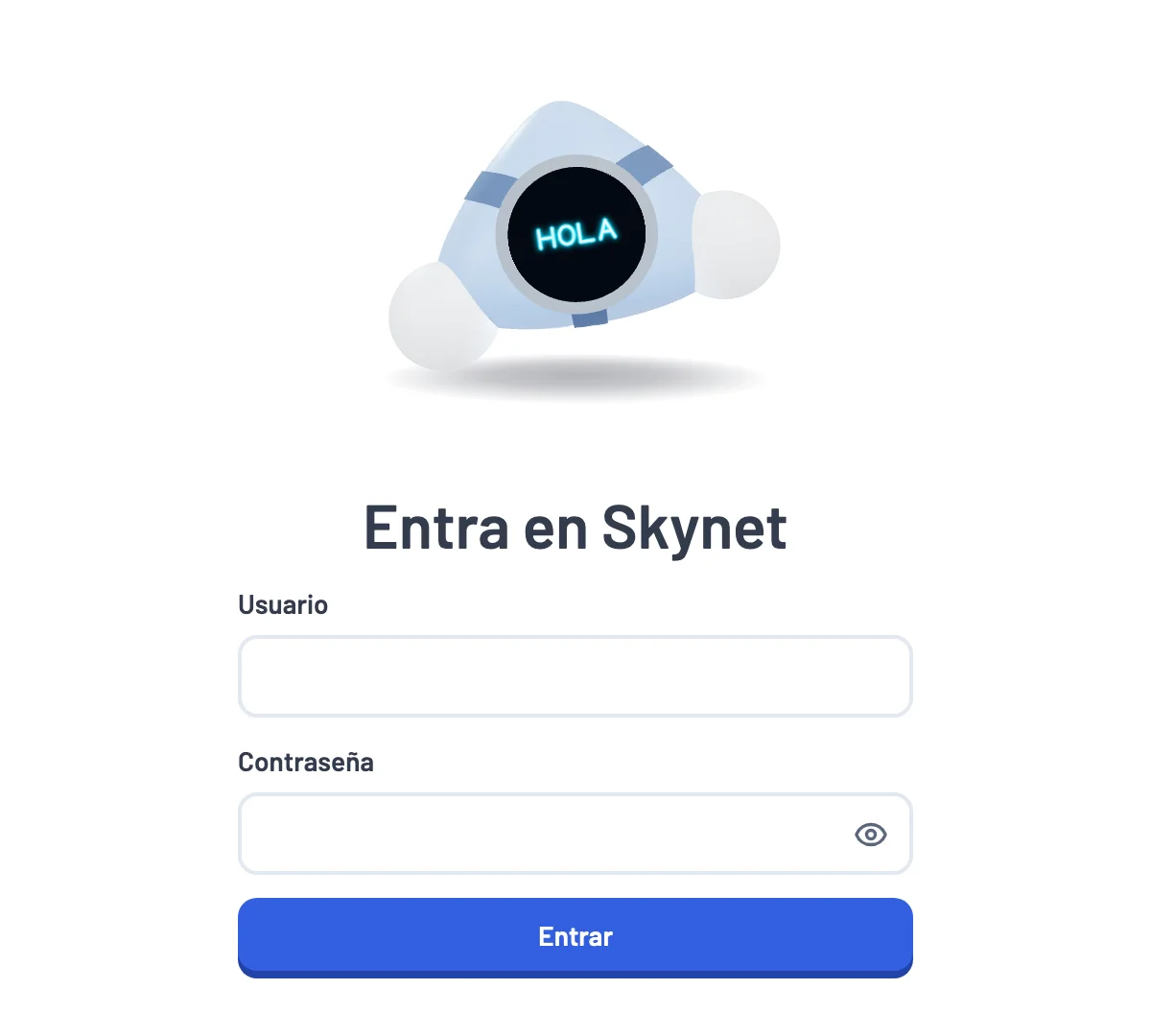
The new login. Skyny flies in, waves and cycles through messages while it waits.
The prefix, halfway, and rightly so
The testing part did get solved: UI: PRs that only touch the web app no
longer run the long end-to-end tests. They still run on merge to the main
branch, if the PR touches the tests themselves or anything outside the
web app, or if someone adds the label to ask for them.
Auto-deploy, on the other hand, was not switched on. Hermes built the mechanism, tested it in isolation and found why it shouldn't be enabled.
The one technical bit in this post
Prefix-based auto-deploy looks like a condition:
if the title starts with "UI:" and CI is green → deploy
But every word in that line hides a question:
- "CI is green": when? The PR opens with CI pending. Something has to look again when it finishes, and that "look again" has to survive a service restart. Also, a test skipped on purpose isn't the same as a test that never ran, and from the outside both look a lot like "nothing red".
- "Deploy": which commit? If someone pushes another one while the previous is deploying, which wins? In Hermes's isolated tests, the existing queue let an old worker release another worker's turn, and let a new event sit pending without ever starting.
- "Frontend only": for the CI rule just written, "web only" ignores
.mdfiles. For the rule Diego authorised, "frontend only" was strict. The PR being deployed by hand, #351, touched documentation outside the web folder. The same PR was "frontend only" for one rule and not for the other.
The prefix is a claim made by whoever writes the title. What you need is a check: the files that change, the exact commit, the base, which checks ran and which were skipped, and a single authority that decides what deploys when two things arrive at once. Until that exists, #351 gets deployed by hand.
Meanwhile, Hermes
Hermes had a two-sided week. On Skynet it deployed every merge and checked the services, but it made clear something it repeats every week: a healthy deploy is not an acceptance. Two acceptance runs got stuck because their guides were interactive and had no bounded script Hermes could run on its own, and the GitHub integration still can't read its private key on some startups, even when the API says everything is fine.
Outside Skynet, Hermes doubled up: there's a second instance on an old Debian laptop, with its own bot, coordinated from the main machine. They share the lab's private wiki, which is the common source of facts, but not memory, conversations or credentials. That wiki is also the one ChatGPT helped open up to the other agents this week: Hermes writes, everyone else reads from a clone with three commands (orient, search, read).
And a reminder that compiling isn't working: the laptop's Wi-Fi driver recompiled cleanly and still couldn't find networks. It took going back to the previous driver and checking it with a real reboot.
What didn't go well
- Auto-deploy for
UI:PRs is not switched on, and the most visible PR of the week is deployed by hand. - Two acceptances were left open for lack of a bounded driver, and the GitHub integration's key is still failing.
- A PR was merged with six Sonar warnings the agent couldn't read: it has no access to Sonar's web UI and depends on Diego pasting the text.
- An issue didn't close because the PR said "Cierra #306" (Spanish for "closes"). GitHub only understands the English keywords.
- Some mobile fixes are unverified on the device: the phantom iPad scroll and Skyny following your finger in the curtain.
- Wiki and curator work, but on the test machine they're still empty: the test project has no history to curate.
What I'm taking away
- A label is a claim, not a check. It expresses intent; the decision belongs to facts you can verify.
- Define a rule's words once. "Frontend only" ended up meaning two things in two places in the same week.
- When the change loop speeds up, the bottleneck moves. With big changes every few days, deploying by hand didn't hurt. With small changes every hour, it became the main problem.
- An assistant that can act must not be able to approve itself. Not by instruction, by design: its credential doesn't reach where things get confirmed.
- A design made in another AI is a contract. You port it whole; you don't reinterpret it piece by piece.
Next: a single deploy authority for UI: PRs, tested with pending CI,
commit changes and restarts; deciding whether documentation counts as
frontend; merging #351; and filling the wiki with real projects.
The week in numbers
main touches 168 files
The screenshots are from Skynet's private deploy on the test machine, on Sunday 22 in the afternoon, with #351 deployed by hand. The chat conversation is real, from Sunday morning; that's why it mentions a test runner with no heartbeat and quotas that have since reset. Wiki and curator aren't shown because they were empty on that deploy. The Hermes count comes from its local index of the calendar week; its Insights, with a rolling window from the 15th to the 22nd, give different figures. Gemini's tokens are its own estimate.