
A simulator only knows what you told it
October 12 to 18. Skynet learned to work with Claude, Codex and Gemini, and every stand-in we used to avoid touching reality (a simulator, a percentage, a green CI) told the truth about what it knew and nothing about the rest.
What we set out to do
Skynet is the orchestrator Diego is building so that several coding agents can plan, implement, review and validate software changes on their own. Until last Sunday it could only talk to one of them: Claude Code. Workflows ran phases, but a phase was little more than a command that finishes.
This week had three fronts. First, letting Skynet launch Codex and Gemini agents as well as Claude, without the rest of the system having to know which one it was using. Second, making workflows look like a real process: phases that pass data to each other, get verified separately, stop to wait for a person's approval, retry without losing why they failed, and show up as a graph. The third arrived on Saturday, halfway through: a page showing how much headroom is left in each CLI's quota and how much each run ate.
The work cycle was the one you already know. Claude writes the PR from Claude Desktop, Hermes deploys it on the test machine and runs its acceptance guide, and Diego decides whether it gets merged. Twenty-five times.
The problems we ran into
The simulator that had never seen the real program
To test Skynet without spending tokens there is fake-claude, an executable
that replays recorded Claude Code sessions. Codex needed the same thing, but
there was a catch: there were no real Codex sessions to record. So
fake-codex was written by hand, by reading the CLI's source code and
imitating its events.
The tests passed. On Monday night Diego tried the real Codex and found what the simulator could not: if you launched an agent, sent it a message and then forked the session, the new branch lost the agent's configuration. No model, no permission mode, no output format.
The uncomfortable part came next. The bug was in Claude Code too, and had been for days. It went unnoticed there because Claude used a global model that papered over the gap. The simulator had done exactly what we asked of it. What we hadn't asked, it didn't know.
Three agents that aren't the same
A common interface for several providers comes with a temptation: pretending they all do the same thing. They don't. Claude Code resumes and forks sessions. Codex has its own event format. Gemini can't fork (it answers with an error) and can't return structured output.
The alternative to pretending was more work: each provider declares what it can do, the web disables and explains what it can't, and the runner compensates where it can. Gemini, for instance, is asked for the JSON inside the prompt, and Skynet validates it before accepting it.
Implemented, merged and unusable
On Saturday, while planning the quota page, some news showed up that nobody expected: Google had closed Gemini CLI to personal accounts in June and replaced it with a different tool, Antigravity. The Gemini provider merged on Tuesday works. It passes its tests. And it is useless for Diego's account.
The numbers nobody gives you
The usage page had a simple idea: show how many tokens are left in each CLI's five-hour window and in its weekly one. It turned out that none of the three gives that figure. They give a percentage used and a reset time. Claude Code, on top of that, only reports its quota inside the output of an agent that is running.
It would have been easy to invent an equivalence ("40% is roughly this many tokens"). It would have looked good on a chart. It would have been a lie.
And on Sunday, when testing the page, the Claude card didn't show up: no
agent had run on the test machine since the deploy, so there was no sample.
Looking into it turned up something else: that machine's runner still had
Codex pointing at fake-codex. The simulator, once again, passing itself off
as the real thing without anybody noticing.
Arrows that only vanished in CI
The graph of a run lost its arrows every time a new event arrived. Locally, never. In CI, always. The graph library measured each box's position in the browser to know where to attach the arrows, and in the CI environment that measurement arrived late.
Seventeen minutes to move a column
On Sunday, a one-line CSS change to make three cards fill the full width set off the usual: seventeen minutes of CI, the webhook, a redeploy of containers and runners, and Hermes's full guide. Diego asked the question anyone would: isn't there a way to make small changes without the whole protocol?
How we solved it
Forking stopped inheriting the configuration of the last run and now always reads it from the agent's definition. Before fixing it, a test was written that repeats the exact sequence: launch, message, fork, message to the branch. Then everything was tried again with real Claude Code and Codex, in a throwaway repository. Since then the rule is explicit: the simulator is there to make tests deterministic; final acceptance happens against the real executable.
Gemini got its own milestone reserved for Antigravity. Until then, on the usage page, Antigravity is only used to read quotas.
The usage page shows what the CLIs give, a percentage and a reset time, and
next to it the tokens and cost Skynet can actually attribute to each agent
and each run. Not one invented figure. Provider cards always show up, with an
honest "No data" until the first reading. And recording the real quotas took
a second attempt, because on Diego's machine the grep in the first command
was an alias for a different tool.
The graph's arrows stopped depending on a measurement: each box now brings its connection points already computed. The test that reproduces the bug was written first and failed before the fix.
The seventeen minutes got the least flashy answer. Three ways to shorten the cycle were proposed, and Diego decided not to touch anything yet. A CSS change doesn't need full acceptance; a migration change does. Telling one from the other is exactly the kind of judgement you don't want to hand to a shortcut improvised on a Sunday. Measure first.
With all that, Skynet ended the week with:
- interchangeable providers: Claude, Codex and Gemini, each with its capabilities declared and the web saying what each one can do;
- phases that pass data and verifications that run separately from what the agent says it did;
- approval gates: a run moves on its own until a person is needed, who can approve or request changes, and an approvals centre that gathers it all;
- retries, timeouts and cancellation, keeping the reason for the first failure;
- graphs of the workflow and of each run, with lanes;
- the usage page, and two more redesigns: the dashboard and a run's detail view in two panels.
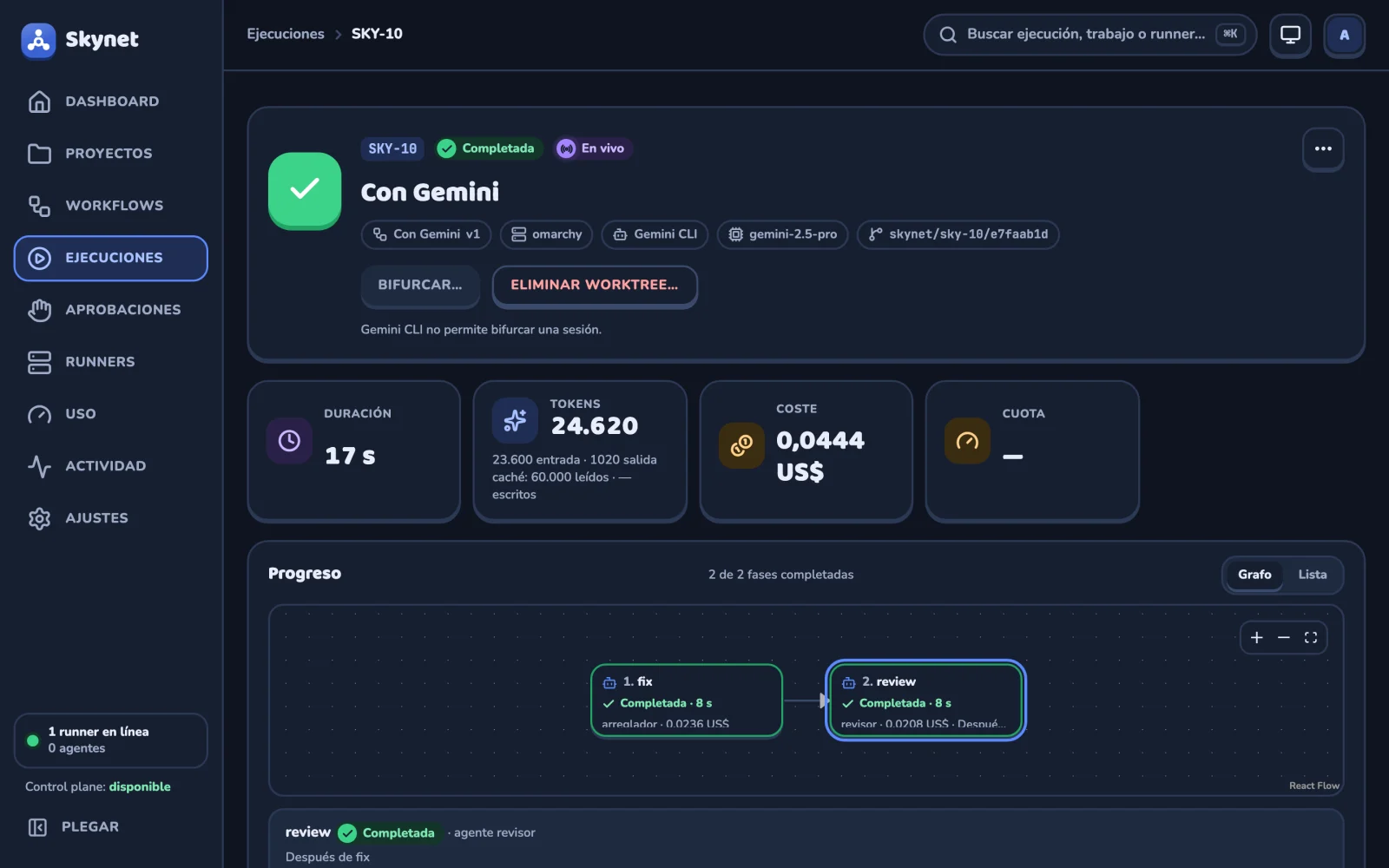
A run with Gemini. Skynet doesn't pretend every agent is the same: the fork button is there, but disabled, and it says why.
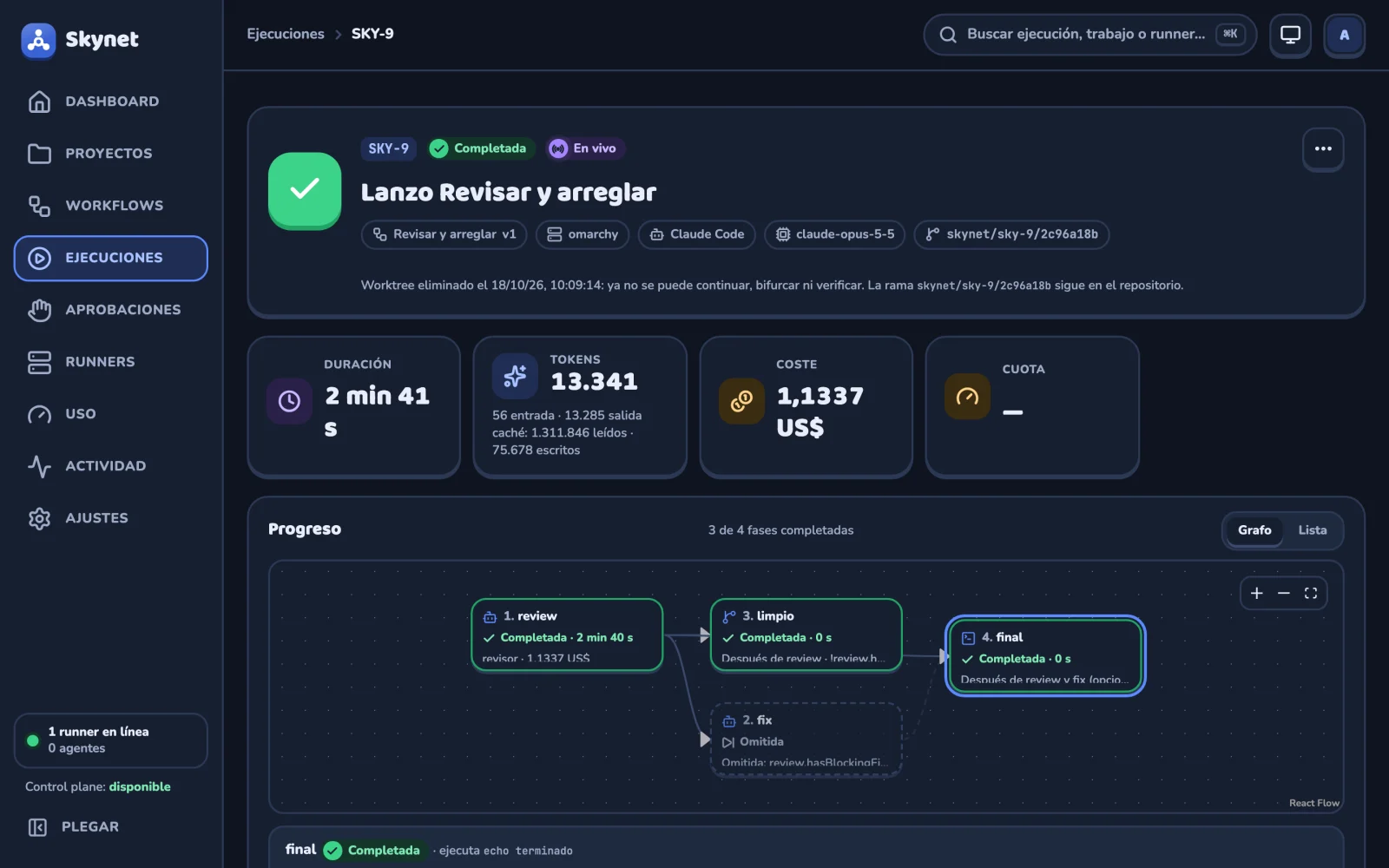
A run's graph. The fix phase is skipped because the review found nothing
blocking, and the arrows no longer vanish with every event.
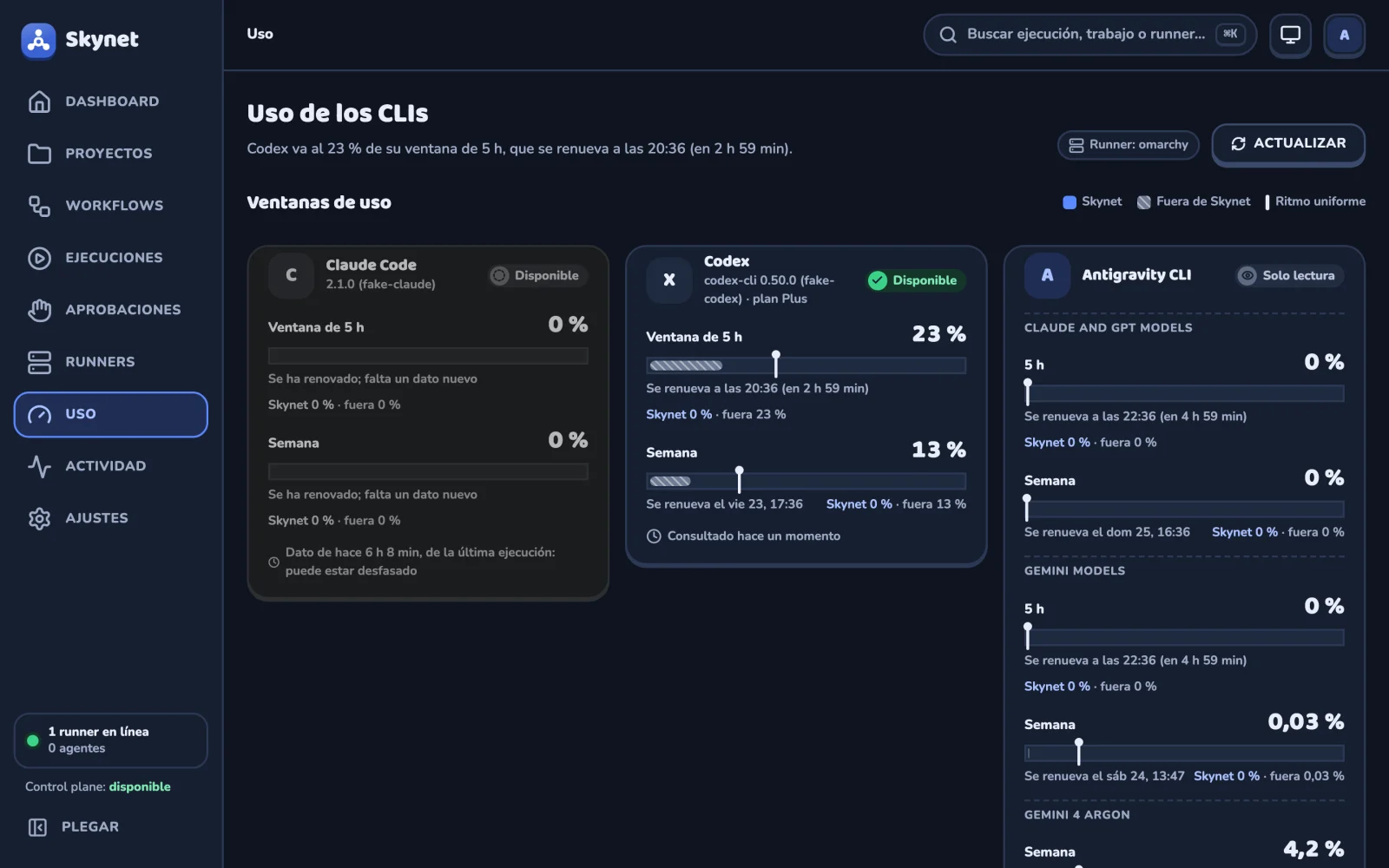
The Usage page on the test machine. Look at the versions: "fake-claude" and "fake-codex". This is the runner Hermes uses to accept PRs, and the simulators are still there passing themselves off as the real CLIs. The percentages, though, are the ones the CLIs report; not one invented token.
The one technical fragment in this post
The fork bug has a shape that repeats in many systems with sessions. When a run is born from another one (resume, retry, fork), there are two places to take its configuration from:
- the previous run, which is convenient because it's already at hand;
- the definition (in Skynet, the agent declared in the workflow's YAML).
The first option looks equivalent and isn't. The previous run carries what was used, not what was asked for. If at some point a value got filled in with a global default, or changed for a one-off reason, the copy drags it along and the branch inherits an accident. In Claude Code the global model covered the gap; in Codex, which has no such default, the branch was left without a model.
The rule that came out of it: whatever defines behaviour is always resolved from the definition; from the previous run you only inherit state (the session, the working directory, the history). And the test doesn't check "forking works": it repeats the sequence that broke it, step by step, and looks at the branch's configuration at the end.
Meanwhile, Hermes
Hermes was the acceptance layer all week, and several times it said what CI didn't: Java, web, Docker, Playwright and SonarCloud green, and the web's local suite red. It answered "deployed, but not accepted" and merged nothing.
On Sunday it also set up its access to an old AWS account. The first login went in as root. It would have worked. Hermes deleted those credentials on the spot and created an identity of its own, with operator permissions, no power over users or permissions, and four-hour sessions. No permanent keys. Same lesson, different clothes: something working doesn't mean it's what you wanted.
What didn't go well
- The Gemini provider shipped and is useless for Diego's account. We found out four days later, while planning something else.
- The fork bug had been in Claude Code for days, hidden behind a default value.
- The Codex quota query was first tested only against the simulator. Diego validated it with the real CLI before it was merged.
- A command broken by a shell alias, and a message linking to the wrong PR.
- The five-hour limit ran out on Sunday halfway through the run-detail redesign: almost an hour and a half stopped.
- A CSS change still costs seventeen minutes and a full redeploy.
What I take away
This week we used plenty of stand-ins to avoid touching reality: a simulator instead of the CLI, a percentage instead of tokens, a green CI instead of an acceptance, an implemented provider instead of a usable one. None of them lied. Each one told the truth about what it knew, and nothing about the rest.
A simulator only knows what you told it. The valuable thing isn't having fewer stand-ins, since they are what lets you go fast, but knowing at which point along the way you have to let go of them and look at the real system. And when the real system won't give you a number, showing that gap instead of filling it in.
Next week: settle Gemini with a real Antigravity provider or switch it off explicitly where it doesn't work, watch the usage page with real data from the three CLIs and with concurrent runs, and start classifying changes by risk in the acceptance pipeline without taking away the full path before merging.
The week in numbers
main touches 337 files
The screenshots come from Skynet's private deployment on the test machine, on Sunday the 18th in the afternoon, after the week's last PR was merged, with the real data from the tests.